Rapid Insights: ‘Sugar’ Turns a Twist Into Character Depth

Apple TV’s Sugar is back for a second season, reaching #2 on Apple TV’s US Top 10 while critics score the new season 100% on Rotten Tomatoes, up from 81% for season one. The gain traces to one choice: the alien twist that landed as a late shock in season one now deepens the detective instead of redefining the show. Colin Farrell’s private detective returns, hunting a boxer’s missing brother while searching for his own vanished sister.

Here’s what you need to know about Sugar:

Vault AI uses index scores to describe the impact a given story/theme/element will have on specific KPIs: 
≤79 Disappointing  80-89 Challenging  90-109 Average  110-119 Promising  120+ Outstanding

Who is watching Sugar?
The men stuck around. Sugar splits evenly between men and women, unusual in a genre that leans female. Netflix’s Dept. Q and Peacock’s Poker Face both run more female, while Bad Monkey, Apple’s other movie-star detective series, lands on the same even profile.

How does season two handle the alien twist?
The reveal becomes the emotional spine, not a plot device. The season stays classic detective fare: Mystery (131) leads the genre data while SciFi sits Average (109), and the case runs on a Dangerous Mission (124) with Sugar as Protector & Guardian (112). The alien origin (Alien Lifeform, 130) now works as character background, reframing Sugar from a cynical detective to a fascinated observer, an outsider whose gentleness toward broken people reads as choice. That deeper emotional investment is what keeps viewers pressing play.

What is pulling viewers in?
The conspiracy outdraws the style. For all the show’s noir polish, Noir (119) trails well behind Secret Organization (143), Sugar‘s strongest pull. Audiences are showing up for the hidden network around John Sugar rather than the trench coat he wears. The emotional data says the same thing: Surprise (124) and Terror (120) lead, the feelings of something concealed forcing its way to the surface. The tension between the show’s warm surface and what’s hiding beneath it is the draw.

Does Sugar have more seasons in it?
Character depth like this renews. Farrell has said he’d love four or five seasons, and the data argues for him: Mysterious Character (114), Family Secret (114) and Moral Dilemma (113) form a Promising cluster that regenerates. New cases arrive, the sister search carries forward, and John Sugar can never stop hiding who he is. Sugar renews on a man who can’t be known.

Introducing Genre DNA™


Redefine your understanding of TV subgenres

Introducing Genre DNA™ – TV subgenres redefined by groundbreaking AI analysis to reveal the true drivers of viewership.

See the insights that others can’t

Genre DNA™ goes beyond traditional TV genre classifications by analyzing over 1,000 scripted and unscripted series on both linear and SVOD platforms from the last 5 years.

Each Vault Genre DNA™ report offers a precise analysis of your chosen TV subgenre, uncovering its unique drivers of viewership.

*Publicly released trailers for series are evaluated using Vault’s algorithms – utilizing our proprietary 120K+ story element database alongside viewership performance and other datasets – to identify unique combinations of stories, themes, characters, and genre elements that will drive success.

Stay in the know

Subscribe to get Rapid Insights delivered to your inbox or follow us on LinkedIn

Past Rapid Insights: Miss one? Check out previous issues here

Rapid Insights: ‘Cape Fear’ Retells a Classic From the Other Side

Apple TV recently premiered Cape Fear, a limited series take on the iconic 1991 Scorsese-De Niro thriller. Scorsese returns as a producer, joined by Steven Spielberg, with Javier Bardem, Amy Adams and Patrick Wilson leading the cast. The story follows Max Cady, a vengeful ex-convict who returns to torment the attorneys who once buried evidence against him, but this time it’s told from the perspective of Anna Bowden (Adams), the attorney with the most to answer for.

Here’s what you need to know about Cape Fear:

Vault AI uses index scores to describe the impact a given story/theme/element will have on specific KPIs: 
≤79 Disappointing  80-89 Challenging  90-109 Average  110-119 Promising  120+ Outstanding

Who’s actually tuning in for a story this well-known?
Scorsese faithful, plus true crime watchers. The Herrmann score, the restaged scenes, and Juliette Lewis’s cameo serve viewers who remember the 1991 film. The wrongful-conviction storyline and the podcast written into the plot pull in a newer audience: viewers who arrived through true crime. Fatal Attraction, Paramount+’s 2023 revival, took the same approach, leaning into its own IP Extension (129) as it recontextualized its villain through a modern lens on personality and control. Cape Fear updates a stalker story for an audience the 1991 film never had.

What makes this more than a remake?
History isn’t carrying it. Connection to the source material sits at only Average (Based on a Book, 107), a modest pull for a story this well-known. The reason is structural: the 1991 film centered on Cady’s standoff with the father of the house, while this version reorients around Anna’s own reckoning with what she did as his attorney. Troubled Past (132) sits inside that reckoning, the compromise she’s never had to answer for until now.

What’s actually pulling people into the story?
It’s the family in danger. Under Threat (160) towers over every other pull, well clear of Seeking Revenge (110), the very payoff the premise promises. Cady wants payback against the attorneys whose past compromise put him away. What keeps viewers watching is subtler: a family realizing how exposed their old decision has left them, years after they assumed it was settled.

What’s keeping viewers hooked?
The law becomes the weapon. Scary Situations (141) and Serving Time (115) lead what’s kept viewers watching so far. Cady uses his own knowledge of the law to stay just out of reach, and Psychological Manipulation (126) tracks that legal maneuvering as closely as it does any physical threat. Six episodes in, that combination keeps viewers coming back each week.

Introducing Genre DNA™


Redefine your understanding of TV subgenres

Introducing Genre DNA™ – TV subgenres redefined by groundbreaking AI analysis to reveal the true drivers of viewership.

See the insights that others can’t

Genre DNA™ goes beyond traditional TV genre classifications by analyzing over 1,000 scripted and unscripted series on both linear and SVOD platforms from the last 5 years.

Each Vault Genre DNA™ report offers a precise analysis of your chosen TV subgenre, uncovering its unique drivers of viewership.

*Publicly released trailers for series are evaluated using Vault’s algorithms – utilizing our proprietary 120K+ story element database alongside viewership performance and other datasets – to identify unique combinations of stories, themes, characters, and genre elements that will drive success.

Stay in the know

Subscribe to get Rapid Insights delivered to your inbox or follow us on LinkedIn

Past Rapid Insights: Miss one? Check out previous issues here

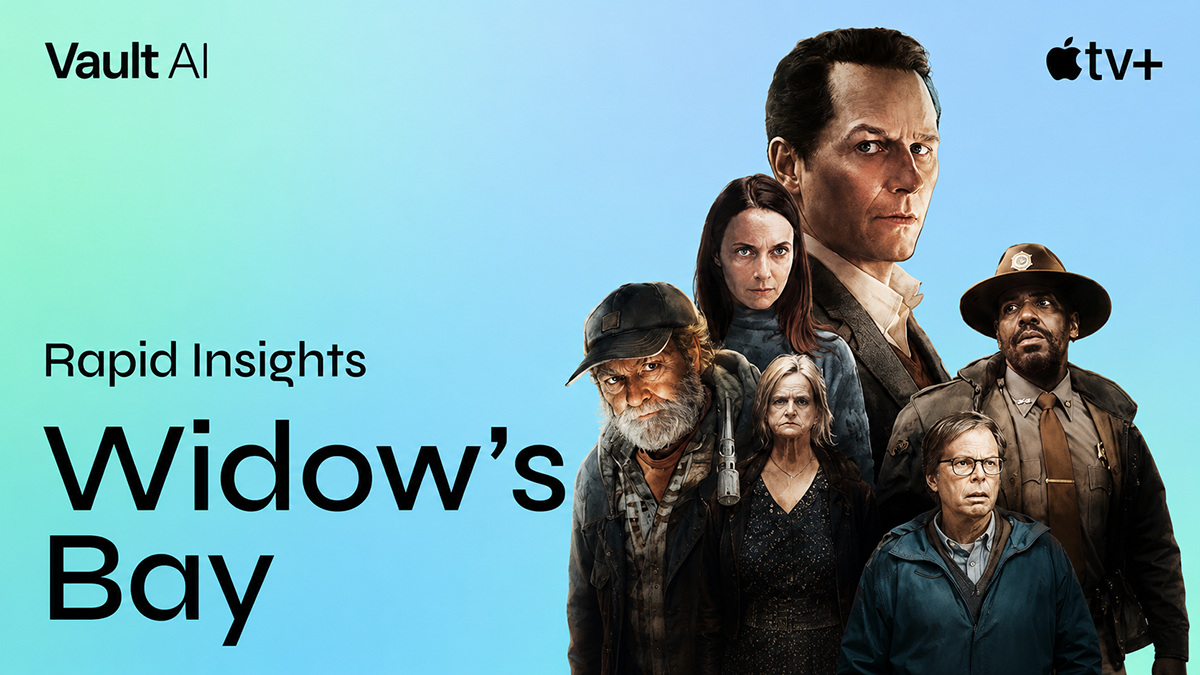
Rapid Insights: ‘Widow’s Bay’ Proves the Punchline Can Also Be the Scare

Widow’s Bay has become one of the year’s most talked-about hits, and Apple TV renewed it for a second season before its finale aired. Katie Dippold’s genre-bending horror-comedy stars Matthew Rhys as the skeptical mayor of a cursed New England island. Behind its 98% Rotten Tomatoes score, Widow’s Bay’s driver profile reveals a series that boldly fuses its scares and laughs.

Here’s what you need to know about Widow’s Bay:

Vault AI uses index scores to describe the impact a given story/theme/element will have on specific KPIs: 
≤79 Disappointing  80-89 Challenging  90-109 Average  110-119 Promising  120+ Outstanding

Who shows up for a comedy that’s also a curse?
An older, adult crowd. Widow’s Bay draws slightly older than Severance, Apple’s other elevated genre swing, but not as old as Bodkin, whose coastal-town mystery draws an even older audience on Netflix. This isn’t a young horror crowd chasing jolts. The audience came for Matthew Rhys and a town that takes its own superstitions seriously, and it stays for a show that plays sincere and absurd at once. The comedy here is built for patience.

Why doesn’t this show alternate between funny and scary?
It’s all one driver. Twisted Humor (160) is what keeps people watching, and it’s also what makes the show frightening. The scene that earns a laugh is also the one that unsettles. Bodkin scores high on Twisted Humor (135) too, but it keeps the jokes separate from the mystery, relying on Criminal Investigation (144) to move the story. Severance plays its dread almost completely straight, building unease through Mysterious Event (118)Widow’s Bay stands out by treating comedy and horror as the same thing.
What does a scare feel like when it’s also a punchline?
Real, even when you’re laughing. The fear here isn’t a gag, it registers as genuine emotion (Fear, 126), the highest note in the show’s emotional profile. That’s the trick of Widow’s Bay: the curse genuinely frightens (Supernatural Force, 121), the islanders’ mishaps genuinely amuse (Awkward Misadventures, 138), and neither feeling cancels the other. You stay scared and entertained in the same breath.

What does Apple see in a town it’s already betting two seasons on?
A place that keeps generating stories. Widow’s Bay’s staying power rests on a renewable setup: a cursed island reinventing itself as a tourist trap, a premise that can swallow new arrivals and old secrets. The human grief gives it real stakes (Widower, 124), while a heightened, anything-goes register lets the show detour into single characters and even century-old flashbacks (Emotions Running High, 121). The show doesn’t need a case to solve. It just needs the island to stay cursed, and the locals to stay spooked.

Introducing Genre DNA™


Redefine your understanding of TV subgenres

Introducing Genre DNA™ – TV subgenres redefined by groundbreaking AI analysis to reveal the true drivers of viewership.

See the insights that others can’t

Genre DNA™ goes beyond traditional TV genre classifications by analyzing over 1,000 scripted and unscripted series on both linear and SVOD platforms from the last 5 years.

Each Vault Genre DNA™ report offers a precise analysis of your chosen TV subgenre, uncovering its unique drivers of viewership.

*Publicly released trailers for series are evaluated using Vault’s algorithms – utilizing our proprietary 120K+ story element database alongside viewership performance and other datasets – to identify unique combinations of stories, themes, characters, and genre elements that will drive success.

Stay in the know

Subscribe to get Rapid Insights delivered to your inbox or follow us on LinkedIn

Past Rapid Insights: Miss one? Check out previous issues here

Rapid Insights: ‘Legends’ Reveals Why Netflix Sent Customs Officers to Do The Wire’s Job

Netflix just dropped Legends, Neil Forsyth’s six-part thriller about UK customs officers who spent years living inside the drug networks they were sent to dismantle. The series arrived to 95% on Rotten Tomatoes and five-star reviews calling it Britain’s answer to The Wire. British crime keeps finding the same audience across platforms because it keeps doing the same thing: a procedural case carrying real personal weight. Slow HorsesDept. Q, and now Legends each put that weight on a different kind of protagonist. Legends goes furthest by handing it to people with the least equipment to carry it.

Here’s what you need to know about Legends:

Vault AI uses index scores to describe the impact a given story/theme/element will have on specific KPIs: 
≤79 Disappointing  80-89 Challenging  90-109 Average  110-119 Promising  120+ Outstanding

Who keeps showing up for British crime drama?
Adults over 35, in steady rotation. Legends draws 52% women and 88% aged 35 or older, mirroring Slow Horses (49% / 88%) and Dept. Q (57% / 89%). The age skew holds across all three. The gender mix shifts with each show’s center of gravity: Dept. Q‘s interior detective work pulls women highest, Slow Horses‘ ensemble action runs more balanced, Legends sits between by carrying both registers. Legends pulls viewers in through Drug Dealing (160) and Criminal Organization (160), the criminal world driving the appeal. Slow Horses leads with Teamwork (123) and Action & Violence (122)Dept. Q with Eccentric Character POV (145) and Team Up (140). Three entry points. One durable audience.

Who does British crime put its cases on?
Anyone but the obvious hero. Slow Horses follows disgraced intelligence agents banished to administrative exile. Dept. Q tracks a senior detective no one wanted, leading a unit no one funded. Legends sends customs officers undercover with no formal training. Each show layers a different personal weight onto its procedural frame, but the casting choice is consistent: the case goes to someone the system already pushed aside. Legends pushes that idea furthest. Secret Identity (160) and Working Undercover (160) sit at the top of the comp set, with Life Changing Decision (145) close behind. Not a dangerous mission, a second life held together by will, and every episode asking when it falls apart.

What keeps audiences coming back after the case is closed?
Investigation is the spine. All three carry the same procedural foundation. What separates them is the weight each adds underneath. Slow Horses brings in Underdogs (113), people the system gave up on. Dept. Q routes through A New Beginning (109), the slow possibility of recovery. Legends layers in Work-Life Balance (119), the home life pulling at the work. Criminal Investigation (127) keeps the procedural frame intact, but Work-Life Balance is the tell. Audiences aren’t only tracking Guy’s operation. They’re tracking what it’s costing him, and whether Sophie sees it before he does.

What does Legends do with people who shouldn’t be there?
The amateurs carry it. The stakes hit differently when the people carrying them aren’t built for the job. Slow Horses runs on agents who used to be sharp. Dept. Q runs on a detective who’s seen everything. Legends runs on customs officers who, weeks earlier, were checking baggage. The emotional profile reflects the restraint: nothing reaches Outstanding. Family (101) sits highest across all three titles, with Slow Horses at 86 and Dept. Q at 85, marking Legends as the show where the lives the operatives left behind still register. British crime drama has long been willing to put its cases on unexpected shoulders. Legends finds the most exposed shoulders yet.

Introducing Genre DNA™


Redefine your understanding of TV subgenres

Introducing Genre DNA™ – TV subgenres redefined by groundbreaking AI analysis to reveal the true drivers of viewership.

See the insights that others can’t

Genre DNA™ goes beyond traditional TV genre classifications by analyzing over 1,000 scripted and unscripted series on both linear and SVOD platforms from the last 5 years.

Each Vault Genre DNA™ report offers a precise analysis of your chosen TV subgenre, uncovering its unique drivers of viewership.

*Publicly released trailers for series are evaluated using Vault’s algorithms – utilizing our proprietary 120K+ story element database alongside viewership performance and other datasets – to identify unique combinations of stories, themes, characters, and genre elements that will drive success.

Stay in the know

Subscribe to get Rapid Insights delivered to your inbox or follow us on LinkedIn

Past Rapid Insights: Miss one? Check out previous issues here

Rapid Insights: ‘Half Man’ Exposes Baby Reindeer Creator’s Secret to a Thriller With No Villain

HBO just premiered Half Man, the follow-up from Baby Reindeer creator Richard Gadd, who stars opposite Jamie Bell as two men who grew up as brothers without sharing a drop of blood. Opening this year’s Canneseries, the show wears a thriller’s surface over something far quieter. The threat isn’t outside the family. It is the family.

Here’s what you need to know about Half Man:

Vault AI uses index scores to describe the impact a given story/theme/element will have on specific KPIs: 
≤79 Disappointing  80-89 Challenging  90-109 Average  110-119 Promising  120+ Outstanding

Who shows up for a story about brothers when nothing’s chasing them?
Adults who’ve already lived it. Half Man lands at 57% women and 73% aged 35+, anchored by Sibling Relationship (128)Adolescence draws comparably at 61% women and 74% aged 35+, but its older audience watches a teenager’s catastrophe from the outside. Baby Reindeer pulls slightly younger at 63% aged 35+, with a stranger doing the damage. Half Man‘s audience doesn’t need an external threat to lean in. They’ve been the brother, the disappointment, the one nobody quite forgave. The show only registers if you’ve been alive long enough to feel it.

What makes a wedding feel like a crime scene?
Family wired like a thriller. Half Man‘s top emotions read like a crime series (Terror 118Surprise 117Fear 116Vengeance 114Aggressiveness 114), but its top story drivers are Flashback Format (130) and Emotional Turmoil (127).  The thriller pulse isn’t coming from a procedural plot. It’s coming from inside the family. Adolescence’s emotions sit average across the same metrics. Baby Reindeer‘s run lower still. Half Man is alone in this gap, and the gap is the show’s whole mechanism.

What kind of mystery is Half Man actually asking viewers to solve?
The kind only a family can hold. Adolescence asks who did it, sustaining through Solving A Murder (135) and Investigators & Detectives (130)Baby Reindeer asked how far it would go, holding on Stalking (160) and Sexual Abuse (152)Half Man‘s mystery is character itself. Why is Ruben in prison. Why hasn’t Niall spoken to him in years. What happened at the wedding that brought police through the door. The show runs that puzzle on Inner Conflict (125)Sibling Rivalry (114), and Feeling Guilty (117), drivers that turn the brothers themselves into the case. Every flashback is evidence. Every silence is testimony.

What gives a story this contained the room to keep running?
Suppression doesn’t expire. Half Man holds over time through Teen Angst (127)Family Conflict (122), and Family Tension (119), all building on the central sibling bond rather than competing with it. Adolescence sustains through the weight of an investigation that has a verdict (The Accused POV, 121)Baby Reindeer ran on Under Threat (131), which expired when the threat did. Half Man‘s engine is different. Every flashback is a new piece of the same withheld conversation. The show keeps running on what the brothers refuse to say to each other, for as long as they refuse to say it.

Introducing Genre DNA™


Redefine your understanding of TV subgenres

Introducing Genre DNA™ – TV subgenres redefined by groundbreaking AI analysis to reveal the true drivers of viewership.

See the insights that others can’t

Genre DNA™ goes beyond traditional TV genre classifications by analyzing over 1,000 scripted and unscripted series on both linear and SVOD platforms from the last 5 years.

Each Vault Genre DNA™ report offers a precise analysis of your chosen TV subgenre, uncovering its unique drivers of viewership.

*Publicly released trailers for series are evaluated using Vault’s algorithms – utilizing our proprietary 120K+ story element database alongside viewership performance and other datasets – to identify unique combinations of stories, themes, characters, and genre elements that will drive success.
Stay in the know

Subscribe to get Rapid Insights delivered to your inbox or follow us on LinkedIn

Past Rapid Insights: Miss one? Check out previous issues here

Rapid Insights: ‘Margo’s Got Money Troubles’ Uses OnlyFans to Sell a Story Apple Didn’t Advertise

Apple TV just dropped Margo’s Got Money Troubles from David E. Kelley and A24 with a 97% Rotten Tomatoes score and a setup that sounds like satire and plays like consequence. A college dropout, pregnant by her professor, turns to OnlyFans to survive. The show wears the creator economy on its surface and runs a reinvention drama underneath.

Here’s what you need to know about Margo’s Got Money Troubles:

Vault AI uses index scores to describe the impact a given story/theme/element will have on specific KPIs: 
≤79 Disappointing  80-89 Challenging  90-109 Average  110-119 Promising  120+ Outstanding

Who is Margo actually pulling in?
More female than anything in its comp set. Margo’s Got Money Troubles projects 68% female and 58% aged 35+, skewing more female than Hacks (60%), Fleabag (58%), and Physical (58%), and landing younger than Physical (82% aged 35+) and Hacks (79%), but closer to Fleabag‘s age profile (55%). That Fleabag overlap is telling. Both shows are adapted from literary source material and built around young women whose lives have just come apart. Lifestyle Change (132)A New Beginning (129), and Journey of Self Discovery (126) carry Margo‘s strongest pull, and Women 35+ are leaning in for the sharp portrait of starting over.

What turns an OnlyFans plotline into compulsive viewing?
Sex work, with footnotes. Sex Work (116) and Sexual Humor (116) anchor Margo‘s early-watch engagement, and Forbidden Love (112) ties the professor thread to real stakes. But Margo isn’t just performing. She’s writing. The same literary skills that earned her professor’s attention now drive an OnlyFans where subscribers pay $20 to have their anatomy compared to Pokemon. The salacious reads as labor with a craft. Fleabag generates early urgency through Family Tension (126) and a protagonist making everything worse for herself. Margo‘s protagonist is moving the opposite direction, toward control.

Why can’t this story end at Season 1?
Wild premise, grounded life. Single Parent (120)Financial Hardship (119)Unexpected Pregnancy (118), and Motherhood (117) anchor the show’s long-term pull, and none of them are plot mechanisms. They’re conditions of Margo’s life that never let up. The premise is wild (OnlyFans income, an ex-wrestler dad coaching strategy, a professor who ghosted) but the reality underneath is bills, diapers, and rent. Fleabag holds through Dating Life (125) and Extended Family (120)Physical sustains through Journey of Self Discovery (122) and Hopefulness (119). What Margo offers is heavier and more relatable. The audience knows what those conditions feel like when they don’t take seasons off. Margo can’t afford to stop, and that turns this from a season arc into a series.

Why does Margo play heavier than its premise?
A drama in comedy’s clothing. Drama leads Margo‘s genre profile (120) over Comedy (110), and the emotional weight class confirms it. Six of Margo‘s top emotions score Outstanding within a single point of each other, putting the show closer to Fleabag and Physical than HacksPensiveness in particular runs higher here (122) than in Fleabag (114) or Physical (115), signaling reflection where viewers expect punchlines. The OnlyFans gets the trailer made. The reflection underneath is what critics noticed at 97% on Rotten Tomatoes.

Introducing Genre DNA™


Redefine your understanding of TV subgenres

Introducing Genre DNA™ – TV subgenres redefined by groundbreaking AI analysis to reveal the true drivers of viewership.

See the insights that others can’t

Genre DNA™ goes beyond traditional TV genre classifications by analyzing over 1,000 scripted and unscripted series on both linear and SVOD platforms from the last 5 years.

Each Vault Genre DNA™ report offers a precise analysis of your chosen TV subgenre, uncovering its unique drivers of viewership.

*Publicly released trailers for series are evaluated using Vault’s algorithms – utilizing our proprietary 120K+ story element database alongside viewership performance and other datasets – to identify unique combinations of stories, themes, characters, and genre elements that will drive success.

Stay in the know

Subscribe to get Rapid Insights delivered to your inbox or follow us on LinkedIn

Past Rapid Insights: Miss one? Check out previous issues here

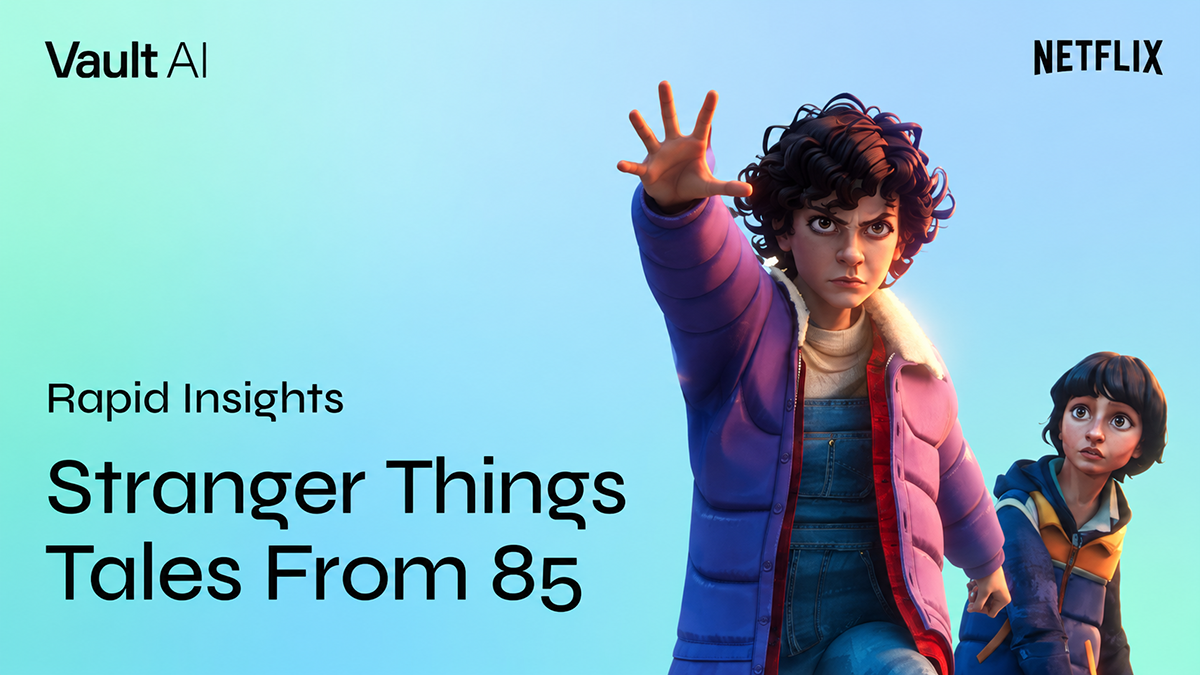
Rapid Insights: ‘Tales from ’85’ Reveals What Stranger Things Trades for Wider Reach

Netflix just dropped Stranger Things: Tales from ’85, an animated spinoff set between Seasons 2 and 3 of the live-action original. Netflix renewed it for Season 2 five days after premiere. The show has been positioned as “entry-level Stranger Things” and described by critics as nostalgia comfort food rather than a creative leap. The data confirms the trade: a wider, younger door into the IP.

Here’s what you need to know about Stranger Things: Tales from ’85:

Vault AI uses index scores to describe the impact a given story/theme/element will have on specific KPIs: 
≤79 Disappointing  80-89 Challenging  90-109 Average  110-119 Promising  120+ Outstanding

Who actually watches a Stranger Things cartoon?
Adults, more than animation alone usually pulls. Tales from ’85 lands at 37% aged 35+, well above the natural ceiling for pure animated sci-fi: Trollhunters: Tales of Arcadia hits 26%, Gravity Falls just 16%. The closest structural comp is Jurassic World: Chaos Theory, another animated Netflix spinoff of a live-action sci-fi IP, which lands at 28% aged 35+. Tales from ’85 clears that mark too. Gender is roughly even across the comp set, but age is where the live-action IP shows up. The original Stranger Things runs at 49% aged 35+. Tales from ’85 doesn’t reach that bar, but IP Extension (124) carries enough adult interest to pull the show meaningfully older than the format alone would predict.

What does 1985 do that nostalgia alone can’t?
The era replaces the dysfunction1980s (145) is what pulls audiences through all ten episodes, ahead of Outdoor Adventure (127) and Small Town Life (116). The original Stranger Things holds its adult audience differently: Sibling Relationship (136) and Coming of Age (131) anchor a heavier core built on family fracture and growing up under threat. Tales from ’85 swaps that for the texture of 1985 itself: walkie-talkies on icy streets, snowplow drivers shouting at kids on bikes, Slim Jims and Space Invaders high scores. The decade is the reason for the rewatch, not the backdrop.

What keeps the show running after the mystery is solved?
Friendships still figuring themselves out. Children’s Friendship (140) leads what keeps audiences invested long after the mystery peaks, with Outdoor Adventure and Small Town Life filling out the Hawkins-as-hometown texture. The original Stranger Things sustains through heavier forces: Family Tension (151)Child POV (149), and A Missing Loved One (140) build a long arc of dysfunction, unease, and grief. Tales from ’85 sustains through something gentler: a group of kids still figuring each other out in a town that keeps sending monsters their way. New companion Nikki Baxter slides into the crew without disturbing what holds it together.

What does “entry-level Stranger Things” actually buy you?
Warmth, not dread. Joy (158) is Tales from ’85‘s highest-scoring emotion, ahead of Family (149) and Social Contact (139). The original Stranger Things tops out at Joy (126)Trollhunters at 130Gravity Falls at 101Tales from ’85 has the warmest emotional fingerprint in the comp set. Upside Down creatures still emerge from snowdrifts, but the dominant feeling is reunion, not threat. The original held its 35+ audience by making the threat feel costly. Tales from ’85 trades that weight for reach, and Season 2’s question is whether it can deepen the dread without losing the audience the lighter format brought in.

Introducing Genre DNA™


Redefine your understanding of TV subgenres

Introducing Genre DNA™ – TV subgenres redefined by groundbreaking AI analysis to reveal the true drivers of viewership.

See the insights that others can’t

Genre DNA™ goes beyond traditional TV genre classifications by analyzing over 1,000 scripted and unscripted series on both linear and SVOD platforms from the last 5 years.

Each Vault Genre DNA™ report offers a precise analysis of your chosen TV subgenre, uncovering its unique drivers of viewership.

*Publicly released trailers for series are evaluated using Vault’s algorithms – utilizing our proprietary 120K+ story element database alongside viewership performance and other datasets – to identify unique combinations of stories, themes, characters, and genre elements that will drive success.

Stay in the know

Subscribe to get Rapid Insights delivered to your inbox or follow us on LinkedIn

Past Rapid Insights: Miss one? Check out previous issues here

Rapid Insights: ‘Malcolm in the Middle’ Shows the Difference Between a Revival and a Reunion

Hulu just dropped Malcolm in the Middle: Life’s Still Unfair, the four-episode revival that scored 8.1 million views in three days to become the streamer’s biggest premiere of 2026. Twenty years after the original wrapped, Frankie Muniz, Bryan Cranston, and Jane Kaczmarek are back for Hal and Lois’s 40th anniversary, with Malcolm dragging a teenage daughter and a girlfriend his parents never knew existed back into the chaos. The driver profile reveals a revival succeeding on terms most sitcom returns won’t risk.

Here’s what you need to know about Malcolm in the Middle: Life’s Still Unfair:
≤79 Disappointing  80-89 Challenging  90-109 Average  110-119 Promising  120+ Outstanding

Who’s actually showing up for this revival?
The audience that survived it. Life’s Still Unfair lands at 57% female and 60% aged 35+, more gender-balanced than Fuller House (74% female, 26% aged 35+) and slightly more female than Saved by the Bell (51% female, 64% aged 35+). Fuller House skews young and female, a comfort-food return for a daughter generation that never wanted the Tanners to age. Saved by the Bell pulls an older crowd through ironic distance, with Self Acceptance (131) giving Gen X license to argue with Bayside about its mistakes. The Malcolm revival sits between them, drawing the original’s Fox audience grown up, gender-balanced enough to suggest couples watching together to see what twenty years of inherited dysfunction looks like at volume.
What separates a revival worth watching from one that just shows up?
It refuses to soften. Fuller House anchors in Supportive Relationships (160) and Mother-Child Relationships (142), the warm ensemble territory that turns a return into a return for the comfort. Saved by the Bell trades on hindsight, with IP Extension (127) and Marital Problems (122) giving Bayside something to revisit with adult eyes. Life’s Still Unfair runs on Family Dysfunction (128) and Over-the-Top Humor (134), the original’s DNA cranked up and applied to adults with real consequences. Hal accidentally takes 60 milligrams of antidepressants the same week he discovers he’s a grandfather. The show isn’t asking viewers to remember the Wilkersons. It’s asking them to recognize what they’ve become.
What keeps audiences locked in episode after episode?
It just gets worse. Awkward & Funny Moments (157) leads the show’s episode-to-episode pull, joined by Family Conflict (138)Family Tension (124), and Arrested Development (123)Fuller House’s comparable hook is Single Parent (129) and Divorced Parents (126), a stable premise audiences can check in and out of without losing the thread. Life’s Still Unfair requires staying. Lois crashes the car driving home from Hal’s drug-induced ego death, then refuses to sit for the anniversary party she’s been organizing all season. Reese is profiting off videos of his father’s humiliations. The show stays with viewers because every episode finds a worse and funnier place to land.

Can a four-episode revival earn a full season?
Inheritance does the work. Multigenerational Family (143)Family Reunion (139), and Family Legacy (132) form the show’s strongest long-term profile, a self-renewing structure rooted in traits the next generation already carries. Fuller House‘s long-tail drivers cluster around the same single-parent territory, with Female Friendship (121)Divorced (121), and Widow (121) all locked into one generation. Life’s Still Unfair works differently. Leah inherits Malcolm’s fourth-wall breaks in the same scene she learns her grandparents are alive. Reese has a wife. Francis has a baby coming. If Hulu greenlights more episodes, the show can keep going because the mess isn’t a plot device. The next generation already has it locked in.

Introducing Genre DNA™


Redefine your understanding of TV subgenres

Introducing Genre DNA™ – TV subgenres redefined by groundbreaking AI analysis to reveal the true drivers of viewership.

See the insights that others can’t

Genre DNA™ goes beyond traditional TV genre classifications by analyzing over 1,000 scripted and unscripted series on both linear and SVOD platforms from the last 5 years.

Each Vault Genre DNA™ report offers a precise analysis of your chosen TV subgenre, uncovering its unique drivers of viewership.

*Publicly released trailers for series are evaluated using Vault’s algorithms – utilizing our proprietary 120K+ story element database alongside viewership performance and other datasets – to identify unique combinations of stories, themes, characters, and genre elements that will drive success.

Stay in the know

Subscribe to get Rapid Insights delivered to your inbox or follow us on LinkedIn

Past Rapid Insights: Miss one? Check out previous issues here

Rapid Insights: ‘The Hunting Party’ Cracks the Code for Addictive Procedural TV

NBC has just premiered an intriguing new mystery-drama-procedural in its mid-season line-up that channels the best of the network’s The BlacklistBlindspot, and Found. This new series follows a small team of special agents as they track down and capture the country’s most dangerous serial killers–all of whom escaped from a top-secret underground prison that officially does not exist.

Here’s what you need to know about The Hunting Party:

Vault AI uses index scores to describe the impact a given story/theme/element will have on specific KPIs: 
≤79 Disappointing  80-89 Challenging  90-109 Average  110-119 Promising  120+ Outstanding

Who’s tuning in for this exciting new crime thriller? 
We’re seeing an audience that leans toward women (60%) and is heavily aged 35+ (94%)–the sweet-spot viewer profile for this broadcast network-led genre. The Hunting Party falls right in line with other villain-of-the-week twisty procedurals like The BlacklistBlindspot, and Criminal Minds.

What is the show’s main hook for viewers?
The Dangerous Missions (146)
. The core general premise of The Hunting Party is by far its biggest selling point, more so than any specifics around characters, plot, or mystery. Audiences are drawn to its intense weekly Psychological Investigations (151) as the team of agents and profilers Races Against Time (129) to stop a succession of notoriously brutal Serial Killers (149) before they can find their next victims (Being Hunted, 114). As is the case with several other serial killer-based dramas (Hannibal, Prodigal SonMindhunterBosch), the murderers themselves as well as the urgent charge to stop them primarily drive the show’s longevity, but they do also contribute to its ratings.

How important are the characters themselves? 
They’re more appealing as a team. The task force assigned to capture the at-large killers is a cross-agency effort combining FBI and CIA special agents (US Federal Agencies, 122), members of the military, and guards from the secret prison, and their overall Team Up (133) and often charged interpersonal dynamics (Co-worker Relationships, 116) will help keep things interesting for viewers–and drive bingeability. However, the individualistic Troubled Past (114) and Inner Conflict (104) of the team’s tense figurehead–criminal profiler Rebecca “Bex” Henderson–is but a much softer draw.

What about the show’s compelling twists and turns? 
They’re a secondary attraction. The mystery of the covertly-run prison that houses hundreds of supposedly-executed serial killers (Secret Organization, 132) and the suspicious, Dark Secrets (111) surrounding it add to The Hunting Party’s watchability. This enigmatic backdrop sets up plenty of cliffhangers during the show’s first season, adding a twist to its core procedural backbone and making it feel different and unique.

How does its social buzz look? 
Encouraging. The late-January sneak peek of the pilot episode spiked its level of online chatter to the “outstanding” level, peaking at (144) out of a max of (160). Repeated airings then kept the show on viewers’ radars, with social buzz hanging out in the high-“promising” to low-“outstanding” range and currently trending upward. It seems very likely that the show will see another big jump with the release of episode two next week.

Most Popular Rapid Insights:


Introducing Genre DNA™


Redefine your understanding of TV subgenres

Introducing Genre DNA™ – TV subgenres redefined by groundbreaking AI analysis to reveal the true drivers of viewership.

See the insights that others can’t

Genre DNA™ goes beyond traditional TV genre classifications by analyzing over 1,000 scripted and unscripted series on both linear and SVOD platforms from the last 5 years.

Each Vault Genre DNA™ report offers a precise analysis of your chosen TV subgenre, uncovering its unique drivers of viewership.

*Publicly released trailers for series are evaluated using Vault’s algorithms – utilizing our proprietary 120K+ story element database alongside viewership performance and other datasets – to identify unique combinations of stories, themes, characters, and genre elements that will drive success.

Stay in the know

Subscribe to get Rapid Insights delivered to your inbox or follow us on LinkedIn

Past Rapid Insights: Miss one? Check out previous issues here

Rapid Insights: American Primeval Explains How History Drives the Modern Western Boom

Earlier this month, Netflix released a dramatic and very buzzy new limited series that immediately scaled its global Top 10 list. Directed by Peter Berg and starring Taylor Kitsch and Betty Gilpin, the show explores a rough and brutal time in the American West: the violent collision of religion, government, and culture in the 1857 fight for control over the Utah Territory.

Here’s what you need to know about American Primeval:

Vault AI uses index scores to describe the impact a given story/theme/element will have on specific KPIs: 
≤79 Disappointing  80-89 Challenging  90-109 Average  110-119 Promising  120+ Outstanding

Who has been tuning in for this intense new western? 
We’re seeing a viewership that’s mostly men (62%) and heavily 30+ (35%)–slightly more skewed than the general sweet spot for TV westerns. While a few other shows in the genre are a close audience match (Deadwood, Lawmen: Bass Reeves), the recent crop of popular oaters, such as Yellowstone1883, Godless, Hell on Wheels, and The Son, tend to be a bit more gender-balanced (52-55% men).

Why have so many viewers been watching?
For the suspenseful thrills. The story follows a mother and young son traveling the rugged west who become ensnared in the brutal, bloody confrontations (Action & Violence, 128) between Utah’s early Mormon settlers, the armed forces of the US government, and the native peoples inhabiting the area. With the help of a Tough Guy (125) who steps in to protect them, they must use their hardened Survival Skills (139) to navigate Scary Situations (136) that put their Lives in Danger (144), and audiences are leaning in for the resulting life-or-death tension.

What’s making this miniseries so bingeworthy? 
Its depiction of a dark episode in American History (130). The Utah War of 1857, an escalating conflict over governance and autonomy within the territory, included the infamous Mountain Meadows Massacre, where a militia disarmed and murdered over 100 uninvolved settlers traveling through to California. The show delves into the Dark Themes (125) and gritty tone of the period, including the many Wild West-style Abuses of Power (123) where the cruel and violent were free to exploit the vulnerable. Viewers are on the edge of their seats to learn whether the mother can protect her son from the massacre, and whether a sympathetic stranger can save them both (Protectiveness, 135).

How is the show’s social buzz? 
Sky-high and sitting pretty. American Primeval’s full episode drop on January 6 rocketed its level of online chatter to the very top of our buzz meter (to an ‘outstanding’ 160), where it has firmly remained ever since. Viewers are talking about the against-all-odds westward journey (Outdoor Adventure, 121) of the show’s vulnerable protagonists (Underdogs, 133) as well as the events’ broader place within American history.

Is the show’s deep dive into American history a selling point internationally?
Not as much as in the US. While American Primeval’s historical angle has an ‘outstanding’ level of pull in a couple of English-speaking markets–namely the UK (125) and New Zealand (129)–the rest of the world is somewhat less interested in such a stereotypically American western story. Instead, the show’s theme of Protectiveness is the most compelling global draw; audiences abroad primarily appreciate seeing the strong defend the weak in such a harsh, cruel environment.

Most Popular Rapid Insights:


Introducing Genre DNA™


Redefine your understanding of TV subgenres

Introducing Genre DNA™ – TV subgenres redefined by groundbreaking AI analysis to reveal the true drivers of viewership.

See the insights that others can’t

Genre DNA™ goes beyond traditional TV genre classifications by analyzing over 1,000 scripted and unscripted series on both linear and SVOD platforms from the last 5 years.

Each Vault Genre DNA™ report offers a precise analysis of your chosen TV subgenre, uncovering its unique drivers of viewership.

*Publicly released trailers for series are evaluated using Vault’s algorithms – utilizing our proprietary 120K+ story element database alongside viewership performance and other datasets – to identify unique combinations of stories, themes, characters, and genre elements that will drive success.

Stay in the know

Subscribe to get Rapid Insights delivered to your inbox or follow us on LinkedIn

Past Rapid Insights: Miss one? Check out previous issues here

Processing...
Thank you! Your subscription has been confirmed. You'll hear from us soon.
Subscribe
Sign up with your email address to receive news and updates.
ErrorHere