
Rapid Insights: ‘The Testaments’ Does What Handmaid’s Tale Never Could

Hulu’s The Testaments is the continuation of one of prestige television’s most politically charged franchises, built by Bruce Miller, who left The Handmaid’s Tale specifically to develop it. The show returns to Gilead, but where its predecessor put audiences inside a system designed to break women, The Testaments follows two teenage girls being shaped by that system and starting to push back. It generated over 11 million hours streamed globally in its first eight days, with episode four drawing 20% more viewers than the premiere. The Handmaid’s Tale held audiences through suffering. The Testaments gives them something to root for instead.

Here’s what you need to know about The Testaments:

Vault AI uses index scores to describe the impact a given story/theme/element will have on specific KPIs: 
≤79 Disappointing  80-89 Challenging  90-109 Average  110-119 Promising  120+ Outstanding

Why does horror keep coming home to women?
Because the trap is always personal. Something Very Bad tracks at 65% women, sitting close to The Haunting of Hill House (68% women) and The Perfect Couple (68% women). Both hold this audience by making the danger feel inescapable, whether it comes from within the family or from a stranger who refuses to leave. What separates Something Very Bad is that the danger isn’t just who she’s marrying. It goes back further than either of them.

Why is the Handmaid’s audience getting younger?
Younger, not different. The Testaments lands at 72% female and 60% aged 35+, holding the female lean of The Handmaid’s Tale (71% female) while five points higher with viewers under 35 (65% aged 35+ for the original). The demo didn’t fragment. It expanded. Female Empowerment (155) scores Outstanding, giving the established base the thematic continuity they came back for, while teen-coded storytelling pulls younger viewers in without asking the originals to leave. The franchise didn’t reinvent itself. It handed the next generation a map.

What keeps audiences locked in episode after episode?
Same voice, new job. Voice-Over Narration (156) is a franchise signature, the device that put audiences inside June’s head for six seasons of endurance. The Testaments passes the voice to Agnes and asks her to do something different: not survive Gilead but see it, one detail at a time, through Journey of Self Discovery (137)The Handmaid’s Tale sustained engagement through Trauma and Tragedy (140), a system grinding people down until survival itself was the story. Severance sustains through Moral Ambiguity (125), a corporation that erodes identity quietly enough that Mark can’t locate the moment it started. All three shows are about systems that work on people. Only one is about a person beginning to work back.

What is actually pulling people in?
Dread with a target. The Testaments scores Outstanding on Terror (125), above Severance (115) and well above The Handmaid’s Tale (104). What’s different is the source. The original generated its fear through the cost of being inside the system. The Testaments generates it through Aggressiveness (125) and Anger (125), scores that outpace The Handmaid’s Tale on both (118 each). Audiences aren’t watching Agnes get hurt. They’re watching her get angry. And they want in.

What keeps the show running past the mythology?
Survival ends. Indoctrination doesn’t. Teen Angst (156) is the show’s strongest long-term hook, ahead of Female Friendship (132) and the journey of self-discovery already established as Agnes’s spine. The Handmaid’s Tale sustained through Broken Family (149), a wound the show kept reopening until the audience couldn’t look away. The Testaments runs on something harder to exhaust: a regime that produces new believers faster than it loses them, and the slow, episode-by-episode work of a girl learning to see what was built around her before she could speak. Gilead keeps producing believers. The Testaments keeps producing the moment one of them stops.

Introducing Genre DNA™


Redefine your understanding of TV subgenres

Introducing Genre DNA™ – TV subgenres redefined by groundbreaking AI analysis to reveal the true drivers of viewership.

See the insights that others can’t

Genre DNA™ goes beyond traditional TV genre classifications by analyzing over 1,000 scripted and unscripted series on both linear and SVOD platforms from the last 5 years.

Each Vault Genre DNA™ report offers a precise analysis of your chosen TV subgenre, uncovering its unique drivers of viewership.

*Publicly released trailers for series are evaluated using Vault’s algorithms – utilizing our proprietary 120K+ story element database alongside viewership performance and other datasets – to identify unique combinations of stories, themes, characters, and genre elements that will drive success.

Stay in the know

Subscribe to get Rapid Insights delivered to your inbox or follow us on LinkedIn

Past Rapid Insights: Miss one? Check out previous issues here

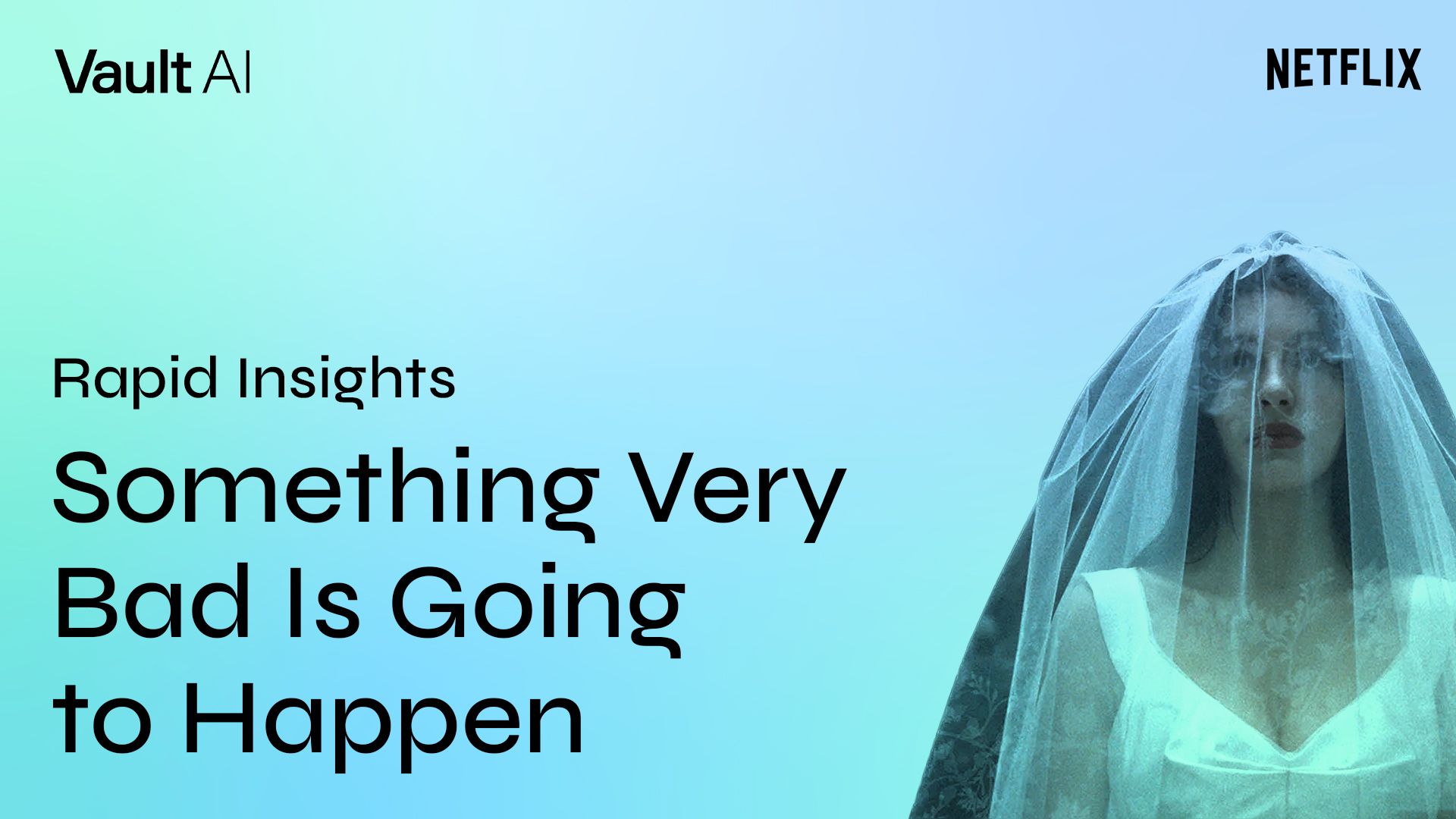
Rapid Insights: ‘Something Very Bad…’ Turns “I Do” Into a Countdown

Netflix just dropped Something Very Bad Is Going to Happen, a horror miniseries from creator Haley Z. Boston and executive producers the Duffer Brothers. A bride named Rachel spends the week before her wedding increasingly certain that marrying the wrong man will kill her. Critics have landed it somewhere between The Haunting of Hill House and Rosemary’s Baby. Boston didn’t make a horror spectacle. She made a wedding story where every reason to leave only makes the staying more terrifying.

Here’s what you need to know about Something Very Bad Is Going to Happen:

Vault AI uses index scores to describe the impact a given story/theme/element will have on specific KPIs: 
≤79 Disappointing  80-89 Challenging  90-109 Average  110-119 Promising  120+ Outstanding

Why does horror keep coming home to women?
Because the trap is always personal. Something Very Bad tracks at 65% women, sitting close to The Haunting of Hill House (68% women) and The Perfect Couple (68% women). Both hold this audience by making the danger feel inescapable, whether it comes from within the family or from a stranger who refuses to leave. What separates Something Very Bad is that the danger isn’t just who she’s marrying. It goes back further than either of them.

What makes a wedding scarier than a haunting?
The altar is the threat. Hill House builds dread through Traumatic Experience (156) and Backstory (146), a family that can never fully escape what happened to it. Something Very Bad inverts that logic entirely. Getting Married (160) and Family Values (137) lead its viewership drivers, meaning the most frightening thing on screen is a ceremony Rachel is choosing to walk toward. That shows up in the emotional profile too. Where Hill House leaves audiences grief-stricken, Something Very Bad generates Disgust (125), well above every comp. Not the dread of a haunting. The visceral reaction to watching someone make a catastrophic choice and being unable to stop them.

Why doesn’t Rachel just leave?
Every reason out makes the staying worse. The Perfect Couple builds its bingeability on Family Dysfunction (141) and Family Secret (129), revelations that surface whenever the family is ready to crack. Something Very Bad doesn’t have that luxury. Wedding Event (127) and Narrative Device (123) lock the story to a hard countdown. The Cunningham family’s tensions are just as loaded, but Rachel doesn’t have episodes to let them unravel naturally. The horror isn’t that she’s trapped. It’s that every episode gives her a new reason to leave and she stays anyway.

Does this show die when the wedding ends?
The wedding ends. The curse doesn’t. The Perfect Couple sustains through Murder Mystery (152) and Family Secret (149), the slow burn of one criminal investigation. Hill House holds through Family Secret (142) and Camaraderie (140), a traumatized family held together across time. Something Very Bad doesn’t need a cold case or a haunted house to keep generating stories. The curse has its own internal logic, and that logic has no expiration date. The show just needs another family, another secret, and another sunset bearing down on someone who isn’t sure they should be standing at that altar.

Introducing Genre DNA™


Redefine your understanding of TV subgenres

Introducing Genre DNA™ – TV subgenres redefined by groundbreaking AI analysis to reveal the true drivers of viewership.

See the insights that others can’t

Genre DNA™ goes beyond traditional TV genre classifications by analyzing over 1,000 scripted and unscripted series on both linear and SVOD platforms from the last 5 years.

Each Vault Genre DNA™ report offers a precise analysis of your chosen TV subgenre, uncovering its unique drivers of viewership.

*Publicly released trailers for series are evaluated using Vault’s algorithms – utilizing our proprietary 120K+ story element database alongside viewership performance and other datasets – to identify unique combinations of stories, themes, characters, and genre elements that will drive success.

Stay in the know

Subscribe to get Rapid Insights delivered to your inbox or follow us on LinkedIn

Past Rapid Insights: Miss one? Check out previous issues here

Rapid Insights: ‘Marshals’ and ‘The Madison’ Reveal What Comes After Yellowstone

CBS’s Marshals and Paramount+’s The Madison arrive weeks apart and make the same argument from opposite ends. A son joining the institution his family always had to account for, never answer to. A mother trying to rebuild a family on ground she didn’t choose. Both shows are set in Sheridan’s Montana. Neither one is really about it. What the land has always done in this universe is apply pressure until something breaks or holds. These two shows reveal that the pressure works on anyone Sheridan decides to put under it.

Here’s what you need to know about Marshals and The Madison:

Vault AI uses index scores to describe the impact a given story/theme/element will have on specific KPIs: 
≤79 Disappointing  80-89 Challenging  90-109 Average  110-119 Promising  120+ Outstanding

How do Marshals and The Madison fit into the broader Sheridan audience?
The shape holds, but both shows push it further. Across the Sheridan catalog, gender splits cluster around 50/50 and the 35-plus crowd accounts for 83–90% of viewership, from Landman (48% female, 83% 35+) to Yellowstone (51% female, 90% 35+). Marshals lands at 54% female and 96% 35+, already nudging past the franchise baseline on both counts. The Madison goes a step further at 57% female and 91% 35+, suggesting Michelle Pfeiffer and a grief-centered family story are drawing women into this universe in a way the Dutton patriarch era rarely did. Same older core. Slightly different center of gravity.

What makes Marshals a different kind of Sheridan show?
Duty without inheritance. Kayce spent years running from the Dutton name, not defending it. Marshals gives its lead a different problem: an institution with a long memory, and a last name that hasn’t made it easy. Honor Under Fire (120) and Complex Team Dynamics (111) are the drivers sustaining this show, and together they tell you the stakes renew through obligation rather than ownership. Where Yellowstone held through Working with Family (148) and Landman through A Focus on Business (132)Marshals runs on the tension between what a badge demands and what a son owes. Teamwork Under Pressure (110) is what keeps that tension productive rather than paralyzing: Kayce doesn’t carry this alone, and the show knows it. That’s a procedural premise. It’s also a Sheridan premise.

What does The Madison ask of its audience that no Sheridan show has before?
To grieve before the story even starts. Every Sheridan family fights to keep something. The Clyburns have already lost it. Where Yellowstone‘s staying power came from Working with Family (148) and Family Tension (144), things worth protecting and fighting over, The Madison builds its viewership around Death of a Loved One (150) and Family Tragedy (126). The grief isn’t the inciting event. It’s the fuel. Sheridan has always used the land to externalize internal stakes. The Madison is the first time those stakes arrive already broken, and the emotions profile confirms the difference: Distraction (136) and Trust (136) lead viewership, suggesting an audience that wants to lose itself in the show but hasn’t decided yet whether it’s earned that.

What do Marshals and The Madison reveal about where Sheridan goes from here?
The crucible keeps finding new people to test. Yellowstone and 1923 put landowning patriarchs at the center. Landman handed that weight to an industry fixer operating outside inherited wealth. Marshals routes it through institutional duty. The Madison routes it through loss. Neither protagonist owns the land the way the Duttons do. What they share is the same thing every Sheridan character shares: Montana is making a demand, and the story is about whether they can meet it. The consistent gender balance across the catalog suggests audiences have always understood this universe wasn’t built for one kind of person. Sheridan isn’t expanding a franchise. He’s proving the thesis he’s been running since 1883.

Introducing Genre DNA™


Redefine your understanding of TV subgenres

Introducing Genre DNA™ – TV subgenres redefined by groundbreaking AI analysis to reveal the true drivers of viewership.

See the insights that others can’t

Genre DNA™ goes beyond traditional TV genre classifications by analyzing over 1,000 scripted and unscripted series on both linear and SVOD platforms from the last 5 years.

Each Vault Genre DNA™ report offers a precise analysis of your chosen TV subgenre, uncovering its unique drivers of viewership.

*Publicly released trailers for series are evaluated using Vault’s algorithms – utilizing our proprietary 120K+ story element database alongside viewership performance and other datasets – to identify unique combinations of stories, themes, characters, and genre elements that will drive success.
Stay in the know

Subscribe to get Rapid Insights delivered to your inbox or follow us on LinkedIn

Past Rapid Insights: Miss one? Check out previous issues here

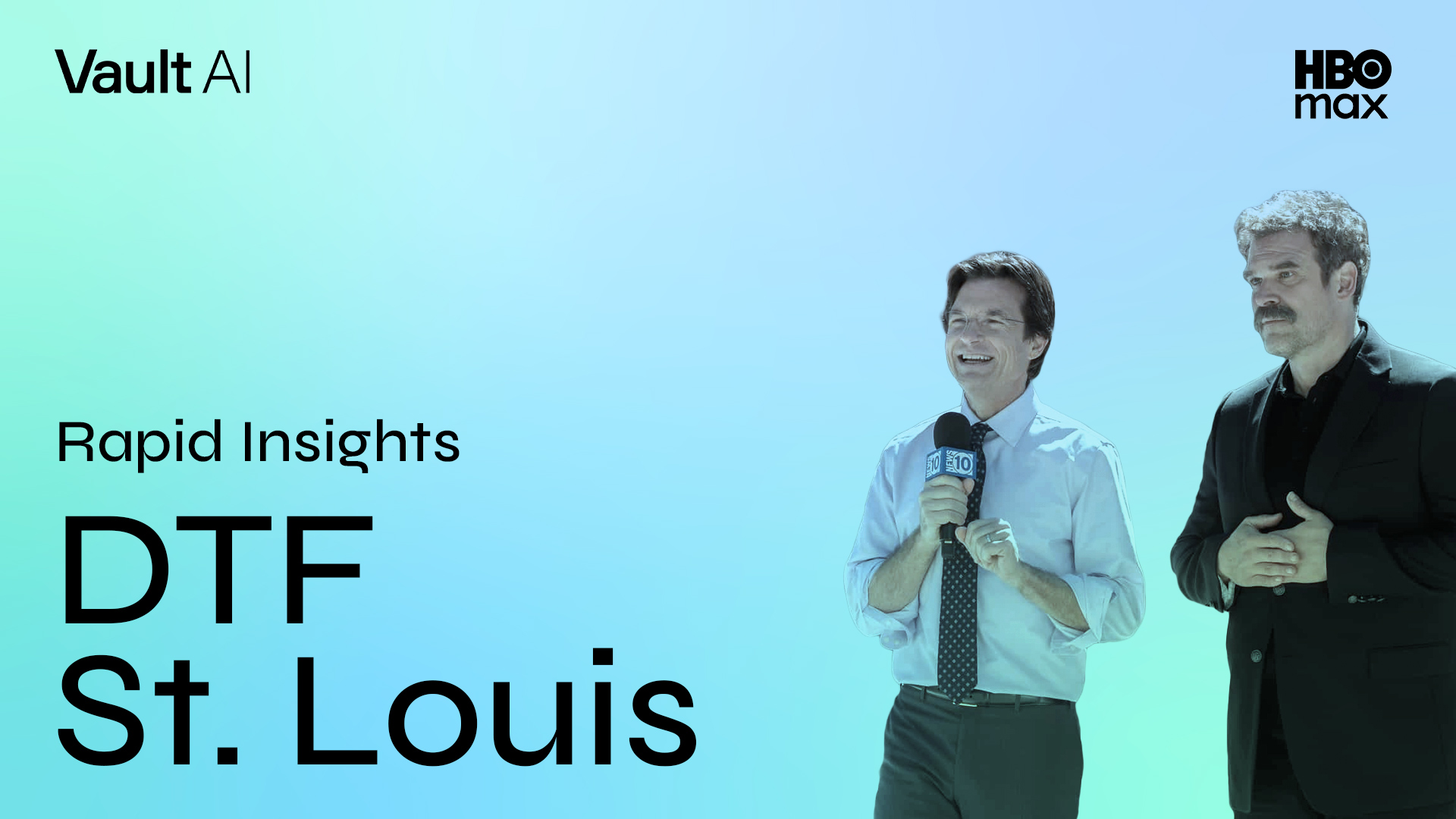
Rapid Insights Film: ‘DTF St. Louis’ Shows an Open Marriage Makes for a Darkly Funny Closed-Case Thriller

HBO just dropped DTF St. Louis, a seven-part dark comedy about two best friends who sign up for a married couples’ infidelity app, and one of them ends up dead. The investigation that follows pulls secrets out of a St. Louis suburb one swipe at a time. It drew 2.5 million viewers in its first three days and has since grown 3.5 times its premiere night audience, now ranking among HBO Max’s top three shows.

Here’s what you need to know about DTF St. Louis:

Vault AI uses index scores to describe the impact a given story/theme/element will have on specific KPIs: 
≤79 Disappointing  80-89 Challenging  90-109 Average  110-119 Promising  120+ Outstanding

Who’s watching two suburban men slowly ruin everything?
Older audiences with a good deal of men, not surprisingly. DTF St. Louis draws 90% of its audience from viewers 35+, closely matching The White Lotus (91% 35+) and well ahead of Dead to Me (65% 35+). Twisted Humor (123) and Sexual Humor (119) drive viewership, suggesting the caustic, sexually-charged tone is sustaining that older male pull. Dead to Me built its 35+ audience through Mother-Child Relationships (139) and Female Friendship (137)The White Lotus built its through Sibling Relationship (112) and Sexual Promiscuity (105)DTF St. Louis earns its audience the direct way: two men who thought an infidelity app was a reasonable idea, and a murder that proves otherwise.

What turns a hookup app into must-watch TV?
Three people who already knew each other too well. Adultery (125) drives the episode-to-episode pull, but the app is almost beside the point. Clark, Floyd, and Carol were already tangled before it gave them new ways to complicate things. A Subculture Up Close (120) adds texture, but it’s the texture of watching people you recognize make decisions you can’t quite believe. Awkward & Funny Moments (118) and Conflict of Interest (117) keep the comedy at a low boil as those decisions start compounding. Dead to Me built its tension around two people managing a shared secret. DTF St. Louis puts three people in a much smaller room and keeps turning up the heat.

What does the murder investigation keep getting wrong?
Everything, in the best possible way. Solving a Murder (131) anchors the show’s staying power, but what makes the investigation compelling is how consistently it reshuffles the deck. The detectives disagree from the start. Surveillance footage points one direction, toxicology another, a traced IP address another. The Playgirl discovery reframes a character entirely. Each episode doesn’t just advance the investigation, it retroactively changes what earlier scenes meant. Investigators & Detectives (113) keep arriving with the same pieces the audience already has, just assembled differently. Where The White Lotus returns to the same volatile dynamics and lets tension accumulate, DTF St. Louis keeps pulling the rug out. The question isn’t just who did it. It’s whether anyone in this story is who they appeared to be.

Why does a show about bad decisions feel this consequential?
Because the stakes were never actually funny. Crime and Mystery both score Outstanding at 123Thriller scores Promising at 114. The comedic premise and the cast’s comedic reputations set a certain expectation, but the story’s DNA runs darker. Vengeance (116) leads the emotional profile, sitting above Romance (112) and Love (110) in a show ostensibly about a love triangle. The feelings were real, but where the story lands isn’t in the romance. It lands in the fallout. Where Dead to Me lets Anger (133) and Vengeance (130) build toward outrage, and The White Lotus settles into sardonic distance, DTF St. Louis holds everything at once, none of it allowed to dominate. The humor doesn’t soften what’s happening to these people. It makes the consequences land harder when they arrive.

Introducing Genre DNA™


Redefine your understanding of TV subgenres

Introducing Genre DNA™ – TV subgenres redefined by groundbreaking AI analysis to reveal the true drivers of viewership.

See the insights that others can’t

Genre DNA™ goes beyond traditional TV genre classifications by analyzing over 1,000 scripted and unscripted series on both linear and SVOD platforms from the last 5 years.

Each Vault Genre DNA™ report offers a precise analysis of your chosen TV subgenre, uncovering its unique drivers of viewership.

*Publicly released trailers for series are evaluated using Vault’s algorithms – utilizing our proprietary 120K+ story element database alongside viewership performance and other datasets – to identify unique combinations of stories, themes, characters, and genre elements that will drive success.

Stay in the know

Subscribe to get Rapid Insights delivered to your inbox or follow us on LinkedIn

Past Rapid Insights: Miss one? Check out previous issues here

Processing...
Thank you! Your subscription has been confirmed. You'll hear from us soon.
Subscribe
Sign up with your email address to receive news and updates.
ErrorHere