Rapid Insights: ‘Widow’s Bay’ Proves the Punchline Can Also Be the Scare

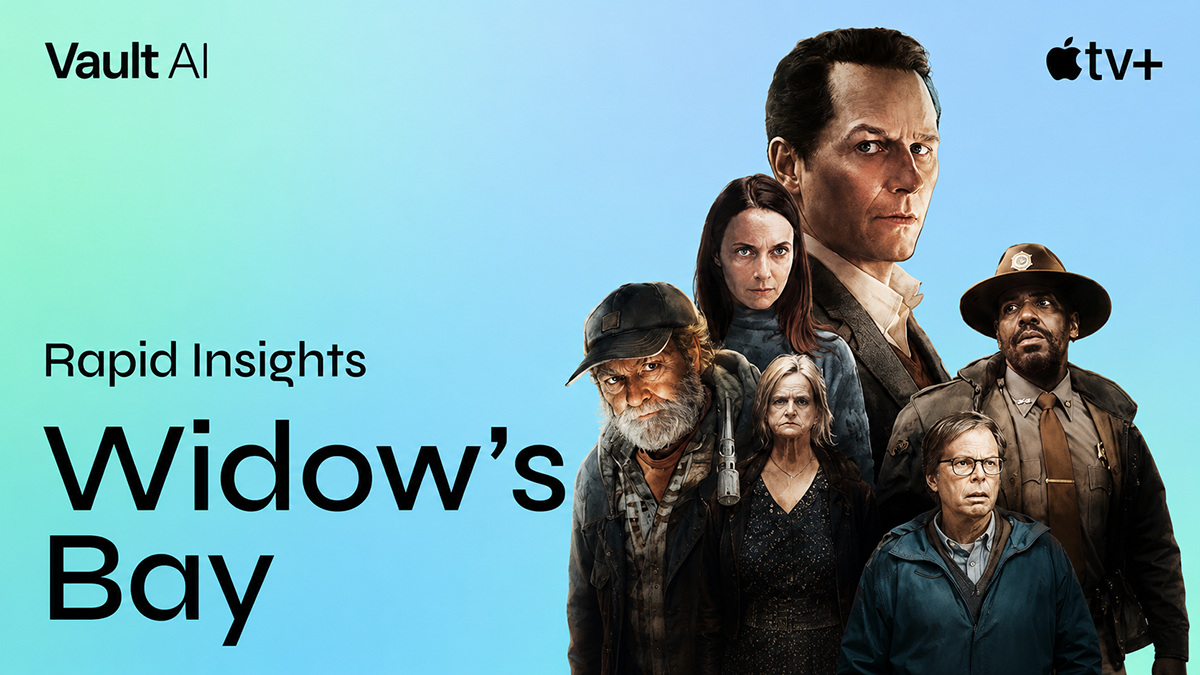
Widow’s Bay has become one of the year’s most talked-about hits, and Apple TV renewed it for a second season before its finale aired. Katie Dippold’s genre-bending horror-comedy stars Matthew Rhys as the skeptical mayor of a cursed New England island. Behind its 98% Rotten Tomatoes score, Widow’s Bay’s driver profile reveals a series that boldly fuses its scares and laughs.

Here’s what you need to know about Widow’s Bay:

Vault AI uses index scores to describe the impact a given story/theme/element will have on specific KPIs: 
≤79 Disappointing  80-89 Challenging  90-109 Average  110-119 Promising  120+ Outstanding

Who shows up for a comedy that’s also a curse?
An older, adult crowd. Widow’s Bay draws slightly older than Severance, Apple’s other elevated genre swing, but not as old as Bodkin, whose coastal-town mystery draws an even older audience on Netflix. This isn’t a young horror crowd chasing jolts. The audience came for Matthew Rhys and a town that takes its own superstitions seriously, and it stays for a show that plays sincere and absurd at once. The comedy here is built for patience.

Why doesn’t this show alternate between funny and scary?
It’s all one driver. Twisted Humor (160) is what keeps people watching, and it’s also what makes the show frightening. The scene that earns a laugh is also the one that unsettles. Bodkin scores high on Twisted Humor (135) too, but it keeps the jokes separate from the mystery, relying on Criminal Investigation (144) to move the story. Severance plays its dread almost completely straight, building unease through Mysterious Event (118)Widow’s Bay stands out by treating comedy and horror as the same thing.
What does a scare feel like when it’s also a punchline?
Real, even when you’re laughing. The fear here isn’t a gag, it registers as genuine emotion (Fear, 126), the highest note in the show’s emotional profile. That’s the trick of Widow’s Bay: the curse genuinely frightens (Supernatural Force, 121), the islanders’ mishaps genuinely amuse (Awkward Misadventures, 138), and neither feeling cancels the other. You stay scared and entertained in the same breath.

What does Apple see in a town it’s already betting two seasons on?
A place that keeps generating stories. Widow’s Bay’s staying power rests on a renewable setup: a cursed island reinventing itself as a tourist trap, a premise that can swallow new arrivals and old secrets. The human grief gives it real stakes (Widower, 124), while a heightened, anything-goes register lets the show detour into single characters and even century-old flashbacks (Emotions Running High, 121). The show doesn’t need a case to solve. It just needs the island to stay cursed, and the locals to stay spooked.

Introducing Genre DNA™


Redefine your understanding of TV subgenres

Introducing Genre DNA™ – TV subgenres redefined by groundbreaking AI analysis to reveal the true drivers of viewership.

See the insights that others can’t

Genre DNA™ goes beyond traditional TV genre classifications by analyzing over 1,000 scripted and unscripted series on both linear and SVOD platforms from the last 5 years.

Each Vault Genre DNA™ report offers a precise analysis of your chosen TV subgenre, uncovering its unique drivers of viewership.

*Publicly released trailers for series are evaluated using Vault’s algorithms – utilizing our proprietary 120K+ story element database alongside viewership performance and other datasets – to identify unique combinations of stories, themes, characters, and genre elements that will drive success.
Stay in the know

Subscribe to get Rapid Insights delivered to your inbox or follow us on LinkedIn

Past Rapid Insights: Miss one? Check out previous issues here

Rapid Insights: ‘Legends’ Reveals Why Netflix Sent Customs Officers to Do The Wire’s Job

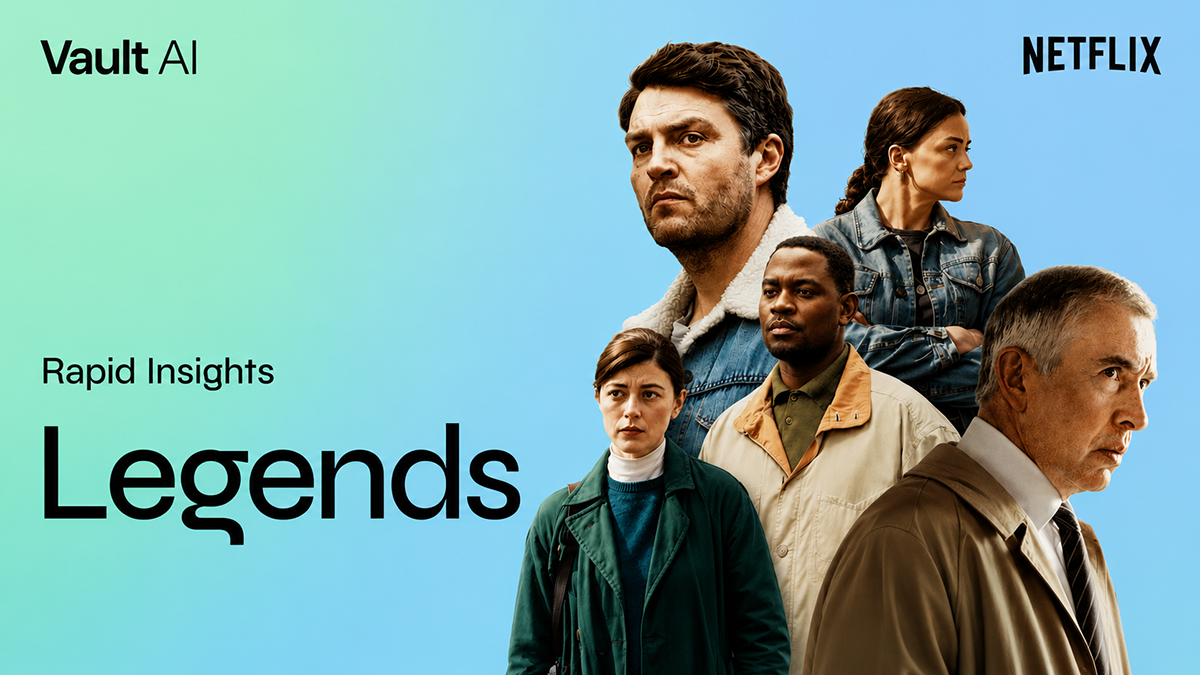
Netflix just dropped Legends, Neil Forsyth’s six-part thriller about UK customs officers who spent years living inside the drug networks they were sent to dismantle. The series arrived to 95% on Rotten Tomatoes and five-star reviews calling it Britain’s answer to The Wire. British crime keeps finding the same audience across platforms because it keeps doing the same thing: a procedural case carrying real personal weight. Slow HorsesDept. Q, and now Legends each put that weight on a different kind of protagonist. Legends goes furthest by handing it to people with the least equipment to carry it.

Here’s what you need to know about Legends:

Vault AI uses index scores to describe the impact a given story/theme/element will have on specific KPIs: 
≤79 Disappointing  80-89 Challenging  90-109 Average  110-119 Promising  120+ Outstanding

Who keeps showing up for British crime drama?
Adults over 35, in steady rotation. Legends draws 52% women and 88% aged 35 or older, mirroring Slow Horses (49% / 88%) and Dept. Q (57% / 89%). The age skew holds across all three. The gender mix shifts with each show’s center of gravity: Dept. Q‘s interior detective work pulls women highest, Slow Horses‘ ensemble action runs more balanced, Legends sits between by carrying both registers. Legends pulls viewers in through Drug Dealing (160) and Criminal Organization (160), the criminal world driving the appeal. Slow Horses leads with Teamwork (123) and Action & Violence (122)Dept. Q with Eccentric Character POV (145) and Team Up (140). Three entry points. One durable audience.

Who does British crime put its cases on?
Anyone but the obvious hero. Slow Horses follows disgraced intelligence agents banished to administrative exile. Dept. Q tracks a senior detective no one wanted, leading a unit no one funded. Legends sends customs officers undercover with no formal training. Each show layers a different personal weight onto its procedural frame, but the casting choice is consistent: the case goes to someone the system already pushed aside. Legends pushes that idea furthest. Secret Identity (160) and Working Undercover (160) sit at the top of the comp set, with Life Changing Decision (145) close behind. Not a dangerous mission, a second life held together by will, and every episode asking when it falls apart.

What keeps audiences coming back after the case is closed?
Investigation is the spine. All three carry the same procedural foundation. What separates them is the weight each adds underneath. Slow Horses brings in Underdogs (113), people the system gave up on. Dept. Q routes through A New Beginning (109), the slow possibility of recovery. Legends layers in Work-Life Balance (119), the home life pulling at the work. Criminal Investigation (127) keeps the procedural frame intact, but Work-Life Balance is the tell. Audiences aren’t only tracking Guy’s operation. They’re tracking what it’s costing him, and whether Sophie sees it before he does.

What does Legends do with people who shouldn’t be there?
The amateurs carry it. The stakes hit differently when the people carrying them aren’t built for the job. Slow Horses runs on agents who used to be sharp. Dept. Q runs on a detective who’s seen everything. Legends runs on customs officers who, weeks earlier, were checking baggage. The emotional profile reflects the restraint: nothing reaches Outstanding. Family (101) sits highest across all three titles, with Slow Horses at 86 and Dept. Q at 85, marking Legends as the show where the lives the operatives left behind still register. British crime drama has long been willing to put its cases on unexpected shoulders. Legends finds the most exposed shoulders yet.

Introducing Genre DNA™


Redefine your understanding of TV subgenres

Introducing Genre DNA™ – TV subgenres redefined by groundbreaking AI analysis to reveal the true drivers of viewership.

See the insights that others can’t

Genre DNA™ goes beyond traditional TV genre classifications by analyzing over 1,000 scripted and unscripted series on both linear and SVOD platforms from the last 5 years.

Each Vault Genre DNA™ report offers a precise analysis of your chosen TV subgenre, uncovering its unique drivers of viewership.

*Publicly released trailers for series are evaluated using Vault’s algorithms – utilizing our proprietary 120K+ story element database alongside viewership performance and other datasets – to identify unique combinations of stories, themes, characters, and genre elements that will drive success.

Stay in the know

Subscribe to get Rapid Insights delivered to your inbox or follow us on LinkedIn

Past Rapid Insights: Miss one? Check out previous issues here

Processing...
Thank you! Your subscription has been confirmed. You'll hear from us soon.
Subscribe
Sign up with your email address to receive news and updates.
ErrorHere