Rapid Insights: ‘Margo’s Got Money Troubles’ Uses OnlyFans to Sell a Story Apple Didn’t Advertise
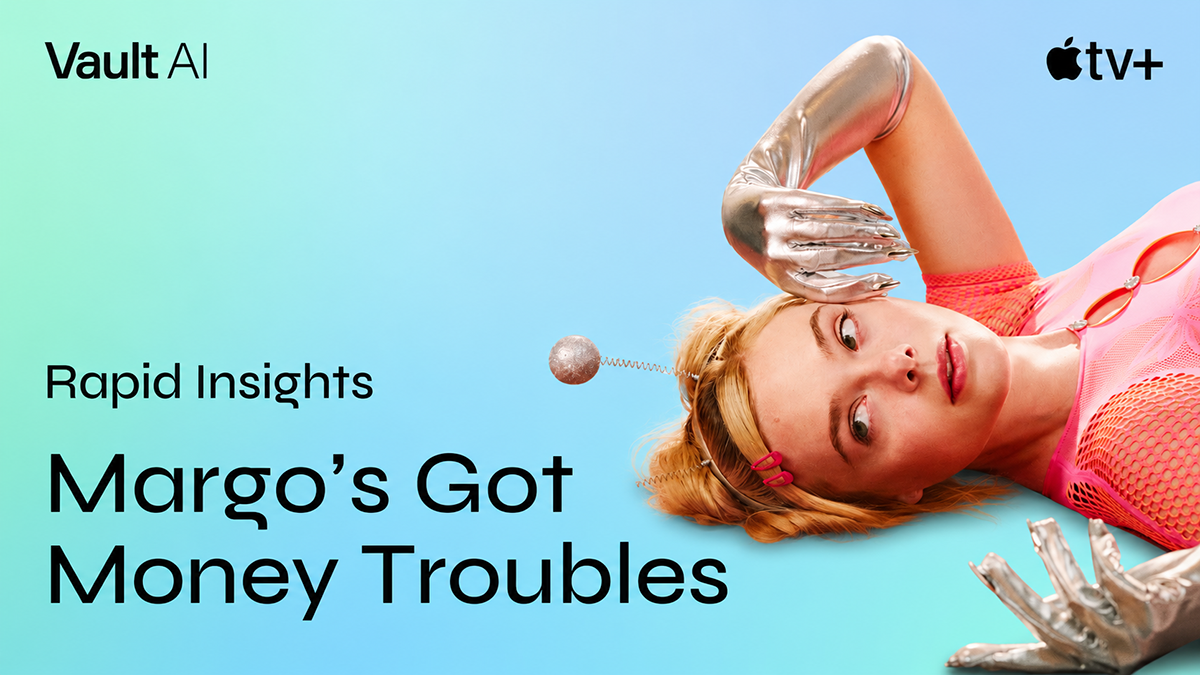
Apple TV just dropped Margo’s Got Money Troubles from David E. Kelley and A24 with a 97% Rotten Tomatoes score and a setup that sounds like satire and plays like consequence. A college dropout, pregnant by her professor, turns to OnlyFans to survive. The show wears the creator economy on its surface and runs a reinvention drama underneath.
Here’s what you need to know about Margo’s Got Money Troubles:
Vault AI uses index scores to describe the impact a given story/theme/element will have on specific KPIs:
≤79 Disappointing 80-89 Challenging 90-109 Average 110-119 Promising 120+ Outstanding
Who is Margo actually pulling in?
More female than anything in its comp set. Margo’s Got Money Troubles projects 68% female and 58% aged 35+, skewing more female than Hacks (60%), Fleabag (58%), and Physical (58%), and landing younger than Physical (82% aged 35+) and Hacks (79%), but closer to Fleabag‘s age profile (55%). That Fleabag overlap is telling. Both shows are adapted from literary source material and built around young women whose lives have just come apart. Lifestyle Change (132), A New Beginning (129), and Journey of Self Discovery (126) carry Margo‘s strongest pull, and Women 35+ are leaning in for the sharp portrait of starting over.
What turns an OnlyFans plotline into compulsive viewing?
Sex work, with footnotes. Sex Work (116) and Sexual Humor (116) anchor Margo‘s early-watch engagement, and Forbidden Love (112) ties the professor thread to real stakes. But Margo isn’t just performing. She’s writing. The same literary skills that earned her professor’s attention now drive an OnlyFans where subscribers pay $20 to have their anatomy compared to Pokemon. The salacious reads as labor with a craft. Fleabag generates early urgency through Family Tension (126) and a protagonist making everything worse for herself. Margo‘s protagonist is moving the opposite direction, toward control.
Why can’t this story end at Season 1?
Wild premise, grounded life. Single Parent (120), Financial Hardship (119), Unexpected Pregnancy (118), and Motherhood (117) anchor the show’s long-term pull, and none of them are plot mechanisms. They’re conditions of Margo’s life that never let up. The premise is wild (OnlyFans income, an ex-wrestler dad coaching strategy, a professor who ghosted) but the reality underneath is bills, diapers, and rent. Fleabag holds through Dating Life (125) and Extended Family (120). Physical sustains through Journey of Self Discovery (122) and Hopefulness (119). What Margo offers is heavier and more relatable. The audience knows what those conditions feel like when they don’t take seasons off. Margo can’t afford to stop, and that turns this from a season arc into a series.
Why does Margo play heavier than its premise?
A drama in comedy’s clothing. Drama leads Margo‘s genre profile (120) over Comedy (110), and the emotional weight class confirms it. Six of Margo‘s top emotions score Outstanding within a single point of each other, putting the show closer to Fleabag and Physical than Hacks. Pensiveness in particular runs higher here (122) than in Fleabag (114) or Physical (115), signaling reflection where viewers expect punchlines. The OnlyFans gets the trailer made. The reflection underneath is what critics noticed at 97% on Rotten Tomatoes.
—
Most Popular Rapid Insights
Introducing Genre DNA™
Redefine your understanding of TV subgenres
Introducing Genre DNA™ – TV subgenres redefined by groundbreaking AI analysis to reveal the true drivers of viewership.
See the insights that others can’t
Genre DNA™ goes beyond traditional TV genre classifications by analyzing over 1,000 scripted and unscripted series on both linear and SVOD platforms from the last 5 years.
Each Vault Genre DNA™ report offers a precise analysis of your chosen TV subgenre, uncovering its unique drivers of viewership.
*Publicly released trailers for series are evaluated using Vault’s algorithms – utilizing our proprietary 120K+ story element database alongside viewership performance and other datasets – to identify unique combinations of stories, themes, characters, and genre elements that will drive success.
