
Rapid Insights Film: ‘Dune: Part Three’ Teaser Outran Part Two’s Trailer in Under a Week

Warner Bros. dropped the first teaser for Dune: Part Three last week to 33.3 million views in six days. That number deserves context. Part Two‘s official trailer sits at 30.7 million views after three years. Part Three‘s teaser passed it in under a week, and it did so by opening with silence, stillness, and sustained dread. The franchise isn’t just sustaining interest, it’s accelerating.

Here’s what you need to know about Dune: Part Three:

Vault AI uses index scores to describe the impact a given story/theme/element will have on specific KPIs: 
≤79 Disappointing  80-89 Challenging  90-109 Average  110-119 Promising  120+ Outstanding

What has each Dune trailer actually been selling?

The franchise’s emotional center of gravity shifted with each film.

Dune: Part One trailer held shots at three to four seconds per cut, nearly twice the industry average, giving audiences the time to absorb a world they’d never seen at that fidelity. Denis Villeneuve’s Visual Spectacle (135) combined with the Hero’s Journey (131) of Paul Atreides, a young heir discovering his destiny on a planet that wants to kill him, were the sell.

Part Two shifted to Political Intrigue (134), compressing the cuts and pushing dialogue forward until the scale of the story felt less like an invitation and more like a warning. Part Two opened 57% higher than Part One.

Part Three goes further still. The top driver is Moral Consequence (144), what happens when the chosen one wins and the cost lands on everyone he loves. Dynastic Legacy (139) sits underneath it, the weight of the Atreides name and a prophecy that was always a trap. Most sequels amplify action and spectacle. Dune has transformed what it’s asking the audience to feel, and the audience has rewarded it each time.

How do you sell tragedy to a blockbuster audience?

Open with dread and hold it.

The teaser’s first 40% of runtime builds slowly, the war chant escalating underneath while the visuals stay still and silent, sustaining Dread (131) through the opening act before earning any spectacle. Part One hit its first Awe peak within 15 seconds. Part Three opens on Paul Atreides standing in the desert, a man who already knows what he’s about to become, and waits until the audience feels the weight of that before delivering Awe (124) in the second half.

Leading with one Outstanding emotion to earn another is a structural choice, and it’s what makes the war imagery land as consequence rather than spectacle. If a campaign’s emotional register doesn’t match where the story actually is, the audience notices.

What does the comment section tell us that the view count doesn’t?

The view count is broad. The engagement behind it is deep.

Music and sound design dominate 20% of comment conversation. The war chant is identified as the teaser’s emotional backbone well above any visual moment, which tracks with how the editors built the entire opening act around sonic escalation rather than imagery.

Book readers are functioning as the franchise’s credibility signal. A deep-lore Dune Messiah callback drew the second most-liked comment, and their visible enthusiasm tells newcomers the adaptation has stayed faithful.

What does Dune: Prophecy reveal about extending this IP to television?

A familiar world isn’t the same as a reason to care.

Dune: Prophecy opened to 1.2 million viewers on HBO Max, a strong debut for prestige television, and its lead drivers, World-Building (127) and Political Intrigue (121), reflect genuine strengths in how it builds out the universe. What the Part Three teaser demonstrates is a complementary approach: leading with emotional stakes anchored in a single character’s trajectory rather than the world around him.

Game of Thrones’ A Knight of the Seven Kingdoms pointed toward the same lesson when its teaser trailer led with the Dunk and Egg relationship rather than the broader Game of Thrones mythology, and the show opened to 14 million viewers per episode as a result.

For any franchise extending across platforms, the question worth asking is less about what the IP can carry and more about who the audience is being asked to follow.

Introducing Genre DNA™


Redefine your understanding of TV subgenres

Introducing Genre DNA™ – TV subgenres redefined by groundbreaking AI analysis to reveal the true drivers of viewership.

See the insights that others can’t

Genre DNA™ goes beyond traditional TV genre classifications by analyzing over 1,000 scripted and unscripted series on both linear and SVOD platforms from the last 5 years.

Each Vault Genre DNA™ report offers a precise analysis of your chosen TV subgenre, uncovering its unique drivers of viewership.

*Publicly released trailers for series are evaluated using Vault’s algorithms – utilizing our proprietary 120K+ story element database alongside viewership performance and other datasets – to identify unique combinations of stories, themes, characters, and genre elements that will drive success.


Stay in the know

Subscribe to get Rapid Insights delivered to your inbox or follow us on LinkedIn

Past Rapid Insights: Miss one? Check out previous issues here

Rapid Insights: ‘Love Story’ Was Always a Cautionary Tale, Just Not His

FX just dropped Love Story: John F. Kennedy Jr. & Carolyn Bessette, now the network’s most-watched limited series on Hulu and Disney+ with 25 million hours viewed. Ryan Murphy has always known how to find the moment a famous life became a cautionary tale and build backward from there. Carolyn Bessette didn’t just marry John Kennedy. She walked into the only family in America that comes with its own mythology, its own press corps, and its own rules about who gets to matter.

Here’s what you need to know about Love Story:

Vault AI uses index scores to describe the impact a given story/theme/element will have on specific KPIs: 
≤79 Disappointing  80-89 Challenging  90-109 Average  110-119 Promising  120+ Outstanding

Who watches a love story when they already know how it ends?
People who were there when it happened. Love Story draws 70% female viewership with 94% aged 35+, a cohort that watched this story unfold in real time through tabloids and cable news, and watched it end as a single line of breaking news. The Crown (64% female, 84% 35+) and American Crime Story: Impeachment (61% female, 88% 35+) pull a similar demo, with each title centering a woman whose public identity is managed by forces outside her control. The Crown stages that tension through Royalty (133)ACS: Impeachment stages it through Courtroom Drama (136)Love Story earns its place through something more intimate: a woman whose professional authority was already fully formed before the most famous name in America walked into her life. Women 35+ remember how Carolyn’s story was told the first time. This show tells it differently.

What emotion drives a show called Love Story?
Not the one in the title. Aggressiveness (115)Anger (115), and Vengeance (115) score Promising as the leading emotional drivers for viewership, sitting well above the softer emotions the title implies. That gap isn’t a tonal mismatch. It reflects something specific about how this audience experiences the show. Viewers aren’t just mourning Carolyn. They’re angry for her. The tabloids and the news cycle asked audiences to feel sad about what happened to her. This show asks them to feel something more active: the specific frustration of watching a capable, self-possessed woman get slowly diminished by forces that were never really about her.

Why does a love story keep returning to Carolyn’s career?
Her career is the show’s real argument. Lifestyle Change (132) and Female Professional (121) reveal that audiences aren’t just tracking a relationship, they’re tracking a dismantling. The show is doing something the tabloids never did: it’s centering Carolyn’s point of view. A self-made woman who built her own authority at Calvin Klein before the Kennedy name arrived and started quietly erasing it. ACS: Impeachment staged the same argument through Celebrity Focus (120) and The Accused POV (113), refusing to let Monica Lewinsky disappear inside a scandal that had already defined her. The Crown routes a similar tension through Strained Relationship (143) and Royalty (133), but Diana’s story is defined by the institution from the start. Carolyn’s runs through professional identity first. For Women 35+ women who watched her story get swallowed by his myth the first time around, that correction is the point.

What’s left to watch once the outcome is already known?
The show doesn’t need a verdict. Family Legacy (155) is what keeps audiences invested long after the romance peaks, and alongside Family Conflict (130), it tells you audiences aren’t watching for resolution. They’re watching for reckoning. ACS: Impeachment sustains on Murder (136) and Criminal Investigation (134), giving audiences a forward-moving trial once the personal story peaks. Love Story has no such mechanism. What it has is the Kennedy name: an institution that follows Carolyn into every room, reframes every choice she makes, and ensures her smallest acts of self-preservation carry impossible weight.

Introducing Genre DNA™


Redefine your understanding of TV subgenres

Introducing Genre DNA™ – TV subgenres redefined by groundbreaking AI analysis to reveal the true drivers of viewership.

See the insights that others can’t

Genre DNA™ goes beyond traditional TV genre classifications by analyzing over 1,000 scripted and unscripted series on both linear and SVOD platforms from the last 5 years.

Each Vault Genre DNA™ report offers a precise analysis of your chosen TV subgenre, uncovering its unique drivers of viewership.

*Publicly released trailers for series are evaluated using Vault’s algorithms – utilizing our proprietary 120K+ story element database alongside viewership performance and other datasets – to identify unique combinations of stories, themes, characters, and genre elements that will drive success.
Stay in the know

Subscribe to get Rapid Insights delivered to your inbox or follow us on LinkedIn

Past Rapid Insights: Miss one? Check out previous issues here

Rapid Insights: ‘Heaven from Belfast’ Works Because It Forgets It’s a Thriller

Greta’s wake had everything except Greta. That’s the premise of How to Get to Heaven from Belfast, and it’s also the problem. Lisa McGee’s first major project since Derry Girls concluded in 2022 carries forward what made that show work: the same creative team, the same Irish wit, the same instinct to find dark comedy in impossible circumstances. What’s changed is the stakes. Three women in their late 30s arrive at a wake, discover the body in the casket isn’t their estranged friend, and realize that finding her means surfacing a secret they all helped bury decades ago. The show earned a 94% on Rotten Tomatoes, with critics noting its ability to stretch tone without breaking it.

Here’s what you need to know about How to Get to Heaven from Belfast:

Vault AI uses index scores to describe the impact a given story/theme/element will have on specific KPIs: 
≤79 Disappointing  80-89 Challenging  90-109 Average  110-119 Promising  120+ Outstanding

What does female friendship look like when the stakes turn lethal?
Friendship, weaponized. Heaven from Belfast draws 60% female viewership with 83% aged 35+, a notably older skew than Derry Girls (70% female, 53% 35+) while closely matching Bad Sisters (67% female, 84% 35+). The female skew sits slightly lower than both comparison titles, and the drivers suggest why: Life in Danger (148) and Scary Situations (139) sit alongside Female Friendship (160) and Friendship Conflict (160), elements that broaden the show’s appeal beyond its female core. Saoirse, Robyn, and Dara aren’t just looking for answers about Greta. They’re protecting a secret they’ve all carried since adolescence, one that makes finding her as dangerous as losing her. McGee’s thesis hasn’t changed: women keep each other alive. What’s changed is the price of getting it wrong.

How does a show make you laugh at a secret that got someone killed?
The darker the secret, the sharper the joke. Death of a Loved One (160) is the strongest episode-to-episode pull for Heaven from Belfast, outpacing Bad Sisters‘ Twisted Humor (117) and Murder (115) by a significant margin. The intrigue isn’t the body in the casket. It’s what the empty casket threatens to surface: a buried journalist, a cult called Heaven’s Veil, and three women who know more than they’re saying. Searching for the Truth (119) and Sarcastic Humor (134) work together here the way they did for Derry Girls: the humor is armor, and the armor keeps cracking. That’s what thirty years of shared secrets does to a friendship. The closer they get to the truth, the harder it is to keep laughing.

Why does a murder mystery play better as a road trip?
The mystery is the excuse. The friendship is the destination. Derry Girls built its world through Feel Good Humor (160)Coming of Age (160), and Awkward & Funny Moments (152), drivers tied to a specific place and life stage. Heaven from Belfast travels differently. Sarcastic Humor pulls viewers through episode after episode, with Underdogs (120) keeping the show alive long after any single mystery resolves. Three women breaking down in remote Irish towns, bickering over diesel and petrol, dragging each other through a mystery none of them fully understands. Every mile generates new friction. Every breakdown reveals something the four walls of a living room never would. It’s less murder mystery than buddy comedy. The secret pulls them across Ireland. The friendship keeps them there.

What separates Heaven from Belfast from its own creative lineage?
The data draws a clean line. Derry Girls kept its darkness at the margins, its genre scores reflecting that: Horror (92)Mystery (88), and Thriller (81), all Average or below. Bad Sisters pushed further, scoring high on Mystery (122) and Thriller (115)Heaven from Belfast goes further still. Horror (125) and Mystery (124) both score Outstanding, territory neither comparison title reaches. Heaven from Belfast‘s emotional profile confirms it: Love (137) and Disgust (134) score alongside Disapproval (130) and Aggressiveness (121). A relocation network with a kill order. A childhood atrocity at a rural religious commune. Three amateur investigators who are also accomplices. The show puts all of that in the same room as genuine warmth and earns it, and the genre scores prove it isn’t an accident.

Introducing Genre DNA™


Redefine your understanding of TV subgenres

Introducing Genre DNA™ – TV subgenres redefined by groundbreaking AI analysis to reveal the true drivers of viewership.

See the insights that others can’t

Genre DNA™ goes beyond traditional TV genre classifications by analyzing over 1,000 scripted and unscripted series on both linear and SVOD platforms from the last 5 years.

Each Vault Genre DNA™ report offers a precise analysis of your chosen TV subgenre, uncovering its unique drivers of viewership.

*Publicly released trailers for series are evaluated using Vault’s algorithms – utilizing our proprietary 120K+ story element database alongside viewership performance and other datasets – to identify unique combinations of stories, themes, characters, and genre elements that will drive success.

Stay in the know

Subscribe to get Rapid Insights delivered to your inbox or follow us on LinkedIn

Past Rapid Insights: Miss one? Check out previous issues here

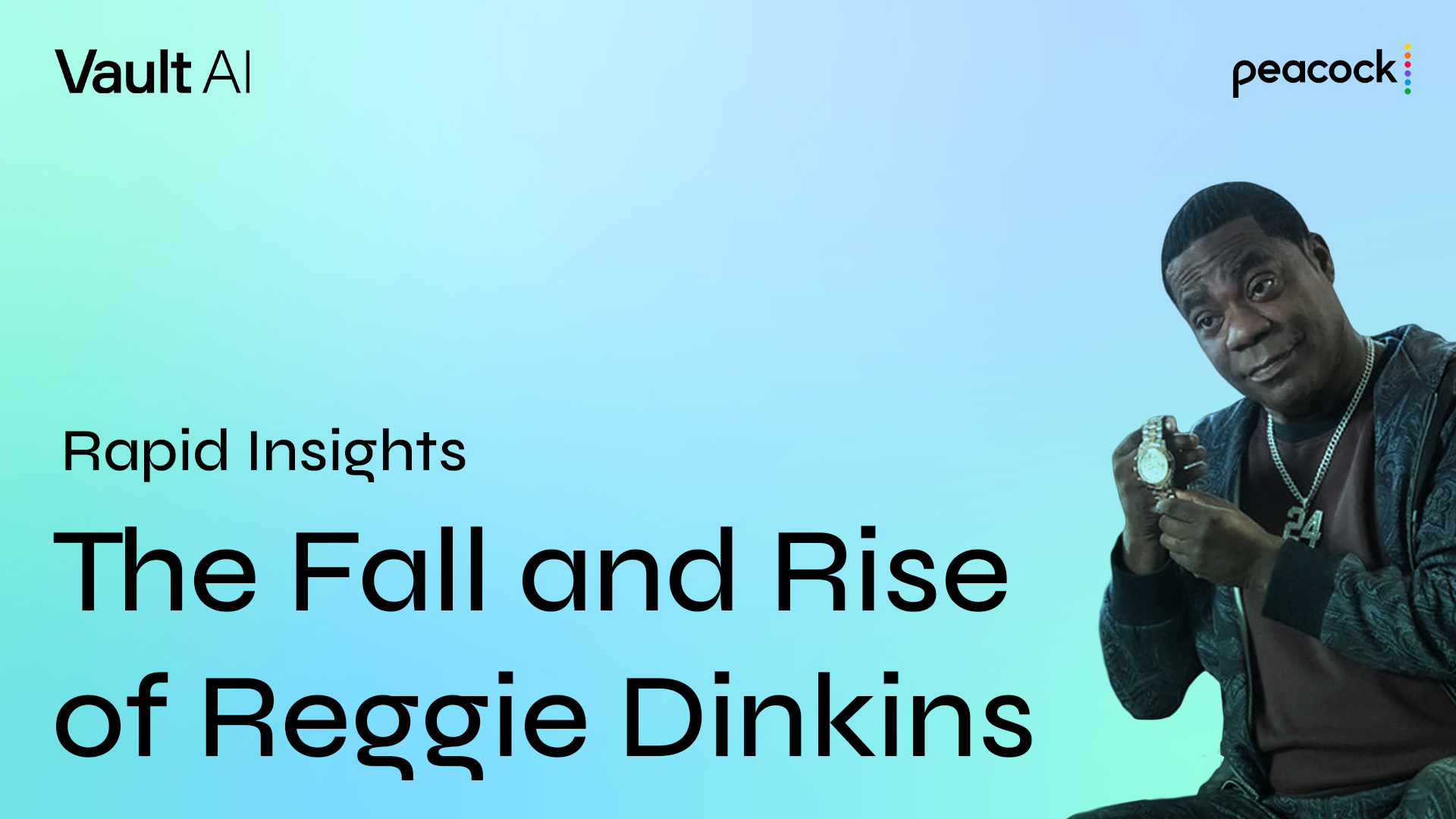
Rapid Insights: ‘Reggie Dinkins’ Proves Audiences Want the Fall, Not the Comeback

Only the creators of 30 Rock could watch a man detonate his NFL career on live television and think: that’s a comedy. The Fall and Rise of Reggie Dinkins carries the creative DNA of Robert Carlock, Sam Means, and Tina Fey, a team that has always understood how institutions seduce, discard, and look absurd once you’re standing outside them. The show presents itself as a sports comeback story, but its driver profile reveals something sharper: an audience tuning in for family dysfunction, public shame, and a disgraced player’s fight to reclaim his Hall of Fame legacy. It’s working. Reggie Dinkins drew 5.8 million viewers in its debut, the biggest comedy premiere on broadcast in three years.

Here’s what you need to know about The Fall and Rise of Reggie Dinkins:

Vault AI uses index scores to describe the impact a given story/theme/element will have on specific KPIs: 
≤79 Disappointing  80-89 Challenging  90-109 Average  110-119 Promising  120+ Outstanding

Who is watching a disgraced NFL star try to rewrite his own story?
An older, evenly split audience. Reggie Dinkins lands at 45% female and 85% aged 35+, tracking closely with Ted Lasso (52% female, 80% 35+) and Stick (47% female, 81% 35+). All three shows wear sports on the surface but broaden their reach through domestic stakes. Family Relationships (157) leads Reggie Dinkins‘ viewership drivers. Ted Lasso edges more female through Feel Good Humor (119) and Dysfunctional Relationship (127), leaning into emotional accessibility over competition. Stick connects through Awkward & Funny Moments (141) and Mentorship (132). The pattern across the comp set: sports comedies reach this demo when the sport is the backdrop and relationships are the hook.

What turns a puff piece into must-watch TV?
The camera won’t blink. Where Ted Lasso leaned on Competitiveness (124) and Stick on Supportive Relationships (134)Reggie Dinkins runs on a rawer engine: the public record of a self-inflicted fall. Public Exposure (News Reports, 140) is the show’s highest bingeability driver, the constant presence of footage that can be replayed, recontextualized, and used against him at any moment. Awkward & Funny Moments (119) and Talking Heads (119) turn that exposure into a rhythm of cringe, confession, and comic release. Arthur Tobin (Daniel Radcliffe), an Oscar winner in his own professional exile, was hired to make a highlight reel. He’s filming something honest instead. Their Unlikely Friendship (112), built on conflicting agendas and a shared need to matter again, is the show’s emotional anchor.

What’s pulling audiences to the couch?
The thrill of watching someone refuse to stop talking. Family (135) dominates Reggie Dinkins‘ emotional profile for viewership, towering over Stick (104) and Ted Lasso (106). But the signature is what surrounds it: Surprise (122) and Terror (122) both score Outstanding, with Aggressiveness (113)Anger (113), and Anticipation (113) all Promising. This isn’t the emotional engine of a feel-good sports comedy. It’s the engine of a show where audiences are leaning forward, waiting for the next unfiltered confession, the next foot-in-mouth moment caught on camera, the next family secret that spills out because a documentary crew happened to be rolling. Ted Lasso ran on optimism and warmth. Reggie Dinkins runs on the electric cringe of a man with no filter and a camera that never stops rolling.

What keeps audiences coming back?
Characters who always have something left to prove. Sports Focus (139) and Road to Redemption (134) anchor the show’s longevity profile. All three comps share the same structural engine: a protagonist who hasn’t earned their place back yet. Stick sustains through Underdogs (137) and Coach-Athlete Relationship (129)Ted Lasso held with Coach-Athlete Relationship (118) and Fish Out of Water (116). What separates Reggie Dinkins is the weight of a known, self-inflicted fall. The show doesn’t need Reggie to reach the Hall of Fame to keep going. It just needs him to keep reaching.

Introducing Genre DNA™


Redefine your understanding of TV subgenres

Introducing Genre DNA™ – TV subgenres redefined by groundbreaking AI analysis to reveal the true drivers of viewership.

See the insights that others can’t

Genre DNA™ goes beyond traditional TV genre classifications by analyzing over 1,000 scripted and unscripted series on both linear and SVOD platforms from the last 5 years.

Each Vault Genre DNA™ report offers a precise analysis of your chosen TV subgenre, uncovering its unique drivers of viewership.

*Publicly released trailers for series are evaluated using Vault’s algorithms – utilizing our proprietary 120K+ story element database alongside viewership performance and other datasets – to identify unique combinations of stories, themes, characters, and genre elements that will drive success.

Stay in the know

Subscribe to get Rapid Insights delivered to your inbox or follow us on LinkedIn

Past Rapid Insights: Miss one? Check out previous issues here

Processing...
Thank you! Your subscription has been confirmed. You'll hear from us soon.
Subscribe
Sign up with your email address to receive news and updates.
ErrorHere