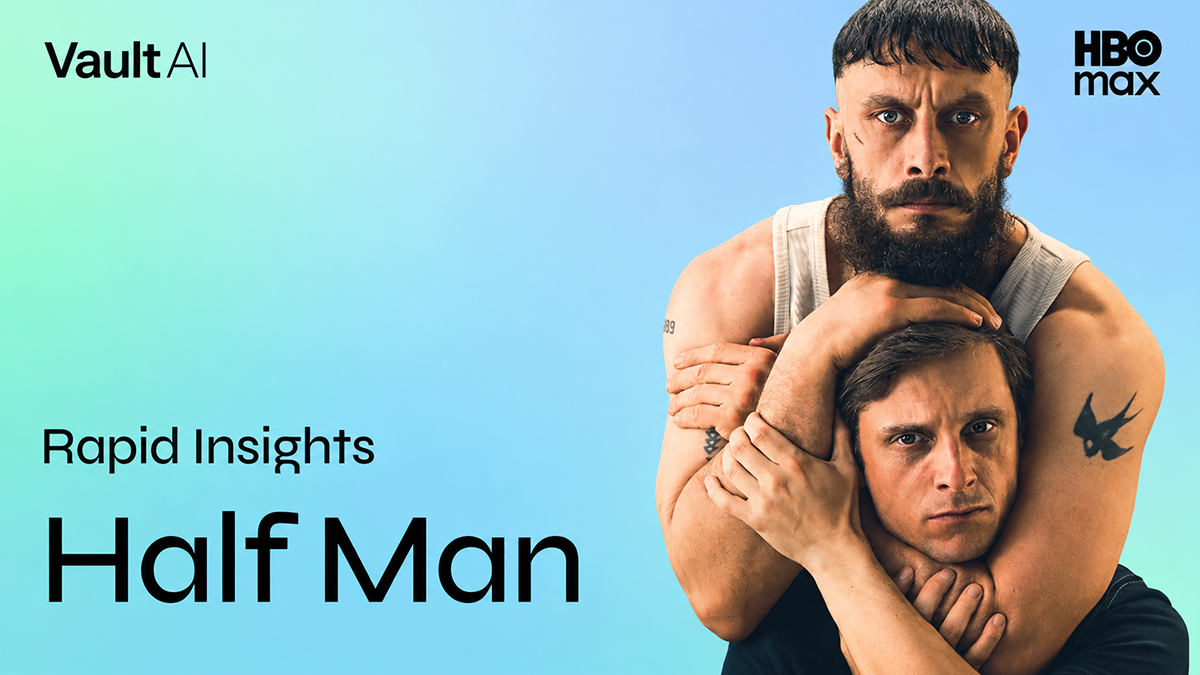
HBO just premiered Half Man, the follow-up from Baby Reindeer creator Richard Gadd, who stars opposite Jamie Bell as two men who grew up as brothers without sharing a drop of blood. Opening this year’s Canneseries, the show wears a thriller’s surface over something far quieter. The threat isn’t outside the family. It is the family.
Here’s what you need to know about Half Man:
Vault AI uses index scores to describe the impact a given story/theme/element will have on specific KPIs:
≤79 Disappointing 80-89 Challenging 90-109 Average 110-119 Promising 120+ Outstanding
Who shows up for a story about brothers when nothing’s chasing them?
Adults who’ve already lived it. Half Man lands at 57% women and 73% aged 35+, anchored by Sibling Relationship (128). Adolescence draws comparably at 61% women and 74% aged 35+, but its older audience watches a teenager’s catastrophe from the outside. Baby Reindeer pulls slightly younger at 63% aged 35+, with a stranger doing the damage. Half Man‘s audience doesn’t need an external threat to lean in. They’ve been the brother, the disappointment, the one nobody quite forgave. The show only registers if you’ve been alive long enough to feel it.
What makes a wedding feel like a crime scene?
Family wired like a thriller. Half Man‘s top emotions read like a crime series (Terror 118, Surprise 117, Fear 116, Vengeance 114, Aggressiveness 114), but its top story drivers are Flashback Format (130) and Emotional Turmoil (127). The thriller pulse isn’t coming from a procedural plot. It’s coming from inside the family. Adolescence’s emotions sit average across the same metrics. Baby Reindeer‘s run lower still. Half Man is alone in this gap, and the gap is the show’s whole mechanism.
What kind of mystery is Half Man actually asking viewers to solve?
The kind only a family can hold. Adolescence asks who did it, sustaining through Solving A Murder (135) and Investigators & Detectives (130). Baby Reindeer asked how far it would go, holding on Stalking (160) and Sexual Abuse (152). Half Man‘s mystery is character itself. Why is Ruben in prison. Why hasn’t Niall spoken to him in years. What happened at the wedding that brought police through the door. The show runs that puzzle on Inner Conflict (125), Sibling Rivalry (114), and Feeling Guilty (117), drivers that turn the brothers themselves into the case. Every flashback is evidence. Every silence is testimony.
What gives a story this contained the room to keep running?
Suppression doesn’t expire. Half Man holds over time through Teen Angst (127), Family Conflict (122), and Family Tension (119), all building on the central sibling bond rather than competing with it. Adolescence sustains through the weight of an investigation that has a verdict (The Accused POV, 121). Baby Reindeer ran on Under Threat (131), which expired when the threat did. Half Man‘s engine is different. Every flashback is a new piece of the same withheld conversation. The show keeps running on what the brothers refuse to say to each other, for as long as they refuse to say it.
—
Most Popular Rapid Insights
Introducing Genre DNA™
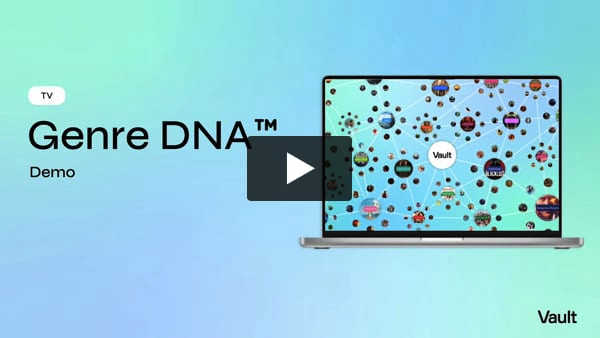
Redefine your understanding of TV subgenres
Introducing Genre DNA™ – TV subgenres redefined by groundbreaking AI analysis to reveal the true drivers of viewership.
See the insights that others can’t
Genre DNA™ goes beyond traditional TV genre classifications by analyzing over 1,000 scripted and unscripted series on both linear and SVOD platforms from the last 5 years.
Each Vault Genre DNA™ report offers a precise analysis of your chosen TV subgenre, uncovering its unique drivers of viewership.
*Publicly released trailers for series are evaluated using Vault’s algorithms – utilizing our proprietary 120K+ story element database alongside viewership performance and other datasets – to identify unique combinations of stories, themes, characters, and genre elements that will drive success.