
Rapid Insights: ‘The ’Burbs’ Asks Who “Safe” Neighborhoods Really Protect

Peacock’s reimagining of the 1989 Joe Dante classic debuted as one of the most-watched streaming originals of the week. The ‘Burbs introduced nosy neighbors, a creepy Victorian house, and a town that calls itself the safest place in America. But the show doesn’t coast on a familiar premise. It uses a recognizable suburban paranoia concept loaded with a point of view the original never had. When Keke Palmer’s Samira moves into her husband’s childhood neighborhood, the danger isn’t just what might be buried under a neighbor’s floor. It’s the question the town’s manicured image refuses to answer: safest for whom?

Here’s what you need to know about The ‘Burbs:

Vault AI uses index scores to describe the impact a given story/theme/element will have on specific KPIs: 
≤79 Disappointing  80-89 Challenging  90-109 Average  110-119 Promising  120+ Outstanding

Who’s watching a dark comedy set in the safest town in America?
Women over 35, and they already love this genre. The ‘Burbs draws 65% female viewership with 75% aged 35+, numbers that map almost exactly onto Only Murders in the Building (62% female, 75% 35+) and Based on a True Story (61% female, 76% 35+). The show’s standout IP Extension (140) tells part of the story: the premise travels. But what The ‘Burbs uniquely offers this audience is a protagonist whose discomfort with the neighborhood runs deeper than the mystery. Samira is a new mother, a city transplant, and an outsider in a place that has decided, long before she arrived, exactly who belongs there and who doesn’t. Nobody is better positioned to notice when the town’s carefully maintained image starts to crack.

What turns a cul-de-sac of strangers into a team?
A found family forged by fear. Only Murders in the Building builds its Unlikely Friendship (128) through genuine warmth between three mismatched neighbors. Based on a True Story binds its duo through a Dysfunctional Relationship (114) and a shared secret. The ‘Burbs earns its Unlikely Friendship (130) through neither. What assembles Samira’s cul-de-sac crew is a towering Scary Situations (141): a neighbor seen buying an axe, a dog fixated on a cellar door, shadows moving behind the windows of the Hinkley House. The show forces people who would never otherwise socialize into a team, and wrings every awkward, horrifying, darkly comic drop out of that dynamic.

What gives The ‘Burbs more staying power than a standard whodunit?
Paranoia has somewhere real to land. The 1989 film played suburban suspicion as comedy, a bored dad who turns out to be mostly right. The 2026 series roots that same suspicion in a 20-year-old cold case and a protagonist who has personal reasons to distrust the neighborhood long before she finds any evidence. A Subculture Up Close (130) isn’t just an atmospheric choice here. It’s the mechanism through which Samira’s outsider status generates both humor and genuine unease. The show’s Murder Mystery (117) carries social weight that Based on a True Story and Only Murders in the Building don’t, because Samira isn’t only investigating what happened to the missing girl. She’s determining whether a town that decides who belongs can ever be safe for someone like her.

What would bring viewers back to Hinkley Hills?
A mystery solved, a town to unravel. Only Murders in the Building proves that audiences return when the investigation team is worth spending time with. Its loyal fanbase is built on the trio Teaming Up (120) to Solve a Murder (128), a combination that tells us the mystery is the engine but the relationships are the fuel. The ‘Burbs matches that profile and adds something new: a protagonist whose position in the neighborhood doesn’t resolve cleanly at the end of a season. The show leaves something larger open, the suggestion that Hinkley Hills’ reputation isn’t just small-town pride but an institution actively maintained, possibly at others’ expense. The danger isn’t one bad neighbor. It’s the neighborhood itself. Audiences aren’t just invested in what happened to the girl gone missing. They’re invested in whether Samira can keep pulling at a string that unravels the whole town.

Introducing Genre DNA™


Redefine your understanding of TV subgenres

Introducing Genre DNA™ – TV subgenres redefined by groundbreaking AI analysis to reveal the true drivers of viewership.

See the insights that others can’t

Genre DNA™ goes beyond traditional TV genre classifications by analyzing over 1,000 scripted and unscripted series on both linear and SVOD platforms from the last 5 years.

Each Vault Genre DNA™ report offers a precise analysis of your chosen TV subgenre, uncovering its unique drivers of viewership.

*Publicly released trailers for series are evaluated using Vault’s algorithms – utilizing our proprietary 120K+ story element database alongside viewership performance and other datasets – to identify unique combinations of stories, themes, characters, and genre elements that will drive success.

Stay in the know

Subscribe to get Rapid Insights delivered to your inbox or follow us on LinkedIn

Past Rapid Insights: Miss one? Check out previous issues here

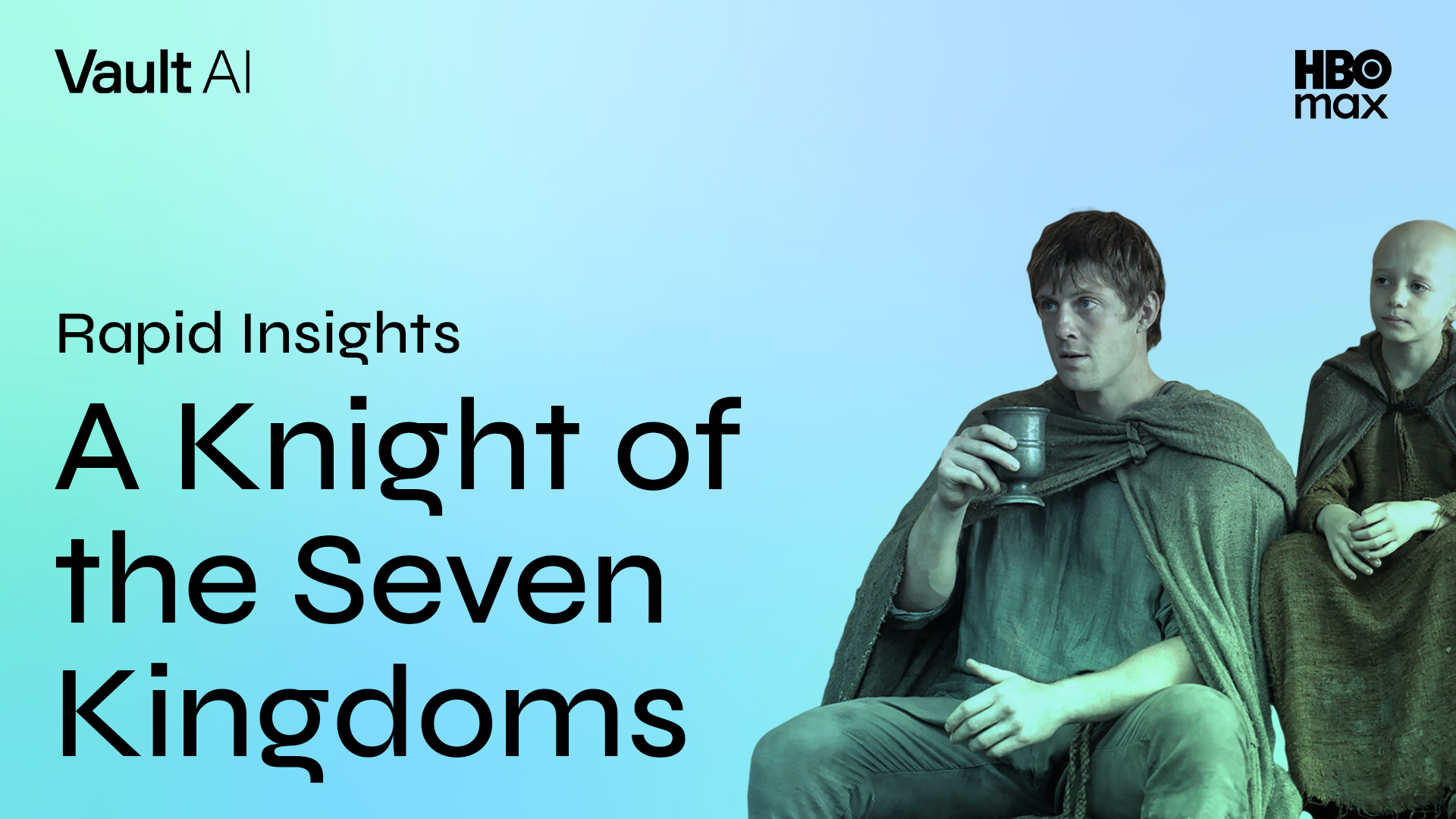
Rapid Insights: ‘A Knight of the Seven Kingdoms’ Exposes the Character Engine Inside Game of Thrones

George R.R. Martin’s newest Game of Thrones prequel launched as one of HBO Max’s top three series debuts, attracting 6.7 million viewers in three days. By trading dragon-sized spectacle for practical swordplay, horseback stunts, and character-driven storytelling, A Knight of the Seven Kingdoms delivered one of the biggest HBO Max debuts, proving the franchise’s audience craved heroes as much as dragons.

Here’s what you need to know about A Knight of the Seven Kingdoms:

Vault AI uses index scores to describe the impact a given story/theme/element will have on specific KPIs: 
≤79 Disappointing  80-89 Challenging  90-109 Average  110-119 Promising  120+ Outstanding

Who is watching a Game of Thrones show without dragons? 
An older, male-leaning audience. AKOTSK skews 62% male with 88% aged 35+, compared to Game of Thrones (53% male, 76% aged 35+) and House of the Dragon (53% male, 90% aged 35+). The male tilt tracks directly to the show’s focus on Physical Activity (136), reflecting the jousting, swordplay, and physical trials of a hedge knight fighting his way into legitimacy, and Honor (128), the chivalric code that defines Dunk’s identity. Both far outpace the franchise’s traditional emphasis on Power (GoT: 128, HotD: 122), signaling an audience drawn to aspirational heroism over political maneuvering.

How does A Knight of the Seven Kingdoms make smallness feel epic?
By grounding stakes in character. AKOTSK reframes franchise storytelling through intimacy rather than spectacle, pairing Action & Violence (120) with Buddy Comedy (117) to relocate tension from the throne room to the bond between hedge knight Ser Duncan “Dunk” the Tall and his diminutive squire, Egg. Bravery (119) and Journey of Self Discovery (112) generate narrative pull not through political scheming but through two people figuring out who they are together. The show’s humor doesn’t play for laughs so much as it reveals character, making Dunk’s naivety and Egg’s quiet cunning feel lived-in and real.

What emotional experience separates this show from the rest of the franchise?
A hero navigating from the bottom up. AKOTSK’s emotional signature clusters around Admiration (117)Submission (114), and Independence (112), three forces that map the internal experience of a lowborn knight in a rigid feudal world. Dunk earns Admiration through action rather than birthright, bends to the rules of a system that wasn’t built for him (Submission), yet continually asserts his own moral code (Independence). Previous franchise entries filtered these same emotions through royals and power brokers. AKOTSK runs them through a nobody with a borrowed sword, and the audience feels the difference.

What keeps viewers coming back week to week?
Common heroism over political schemes. AKOTSK sustains momentum through Dunk’s drive to Overcome Adversity (134) in the Trial of the Seven and outlast his Competition (126), Prince Aerion Targaryen. As battle lines form, the warmth between Dunk and Egg anchors the emotional throughline, giving audiences a relationship to root for rather than a power struggle to decode. Strong IP Extension (118) signals a sustainable franchise blueprint: a hedge knight and his sharp-witted squire, stumbling through a richly realized world together.

Introducing Genre DNA™


Redefine your understanding of TV subgenres

Introducing Genre DNA™ – TV subgenres redefined by groundbreaking AI analysis to reveal the true drivers of viewership.

See the insights that others can’t

Genre DNA™ goes beyond traditional TV genre classifications by analyzing over 1,000 scripted and unscripted series on both linear and SVOD platforms from the last 5 years.

Each Vault Genre DNA™ report offers a precise analysis of your chosen TV subgenre, uncovering its unique drivers of viewership.

*Publicly released trailers for series are evaluated using Vault’s algorithms – utilizing our proprietary 120K+ story element database alongside viewership performance and other datasets – to identify unique combinations of stories, themes, characters, and genre elements that will drive success.

Stay in the know

Subscribe to get Rapid Insights delivered to your inbox or follow us on LinkedIn

Past Rapid Insights: Miss one? Check out previous issues here

Rapid Insights: ‘Finding Her Edge’ Reveals the One Thing Standing Between YA and an Adult Audience

Netflix’s Finding Her Edge isn’t supposed to work for adults. It’s a TV-14 YA sports romance based on a teen novel, built around figure skating, love triangles, and sisterly rivalry. Yet the show’s driver profile tells a different story entirely, one where financial ruin, family obligation, and professional ambition replace school dances and summer flings. Finding Her Edge uses every tool in the YA playbook. It just raises the price of getting it wrong.

Here’s what you need to know about Finding Her Edge:

Vault AI uses index scores to describe the impact a given story/theme/element will have on specific KPIs: 
≤79 Disappointing  80-89 Challenging  90-109 Average  110-119 Promising  120+ Outstanding

Who’s actually watching a teen skating drama? 
Not who you’d expect. Early viewership data shows Finding Her Edge trending 76% female and 80% aged 35+, a significantly older and more female-skewing audience than Heartstopper (58% female, 42% aged 35+) or The Summer I Turned Pretty (82% female, 48% aged 35+). The female affinity is consistent across all three, but Finding Her Edge separates itself on age, suggesting something in its storytelling is connecting with viewers well past their YA years.

Why does teen angst play older here than anywhere else?
Survival stakes, not summer stakes. Finding Her Edge and The Summer I Turned Pretty are both book-adapted YA romances with strong female audiences and sibling dynamics baked in. But TSITP frames its emotional world through Partying (121), Coming of Age (121), and Sibling Relationship (116): low-consequence settings where the worst outcome is a broken heart. Finding Her Edge cranks those same YA ingredients to even stronger levels with Teen Angst (160)Sibling Relationship (156), and Tough Decisions (144), routing emotional turbulence through a family skating dynasty hemorrhaging money. Adriana’s angst isn’t about who she’s kissing at a beach house. It’s about whether her competitive comeback can generate enough sponsorship dollars to keep her family from losing everything.

What keeps viewers locked in ?
Identity under siege. Teen Angst (143) drives episode-to-episode urgency, but it’s the supporting cast of drivers that reveals why this show sustains beyond its genre. Coming of Age (125) and Teen Romance (116) keep the romantic tension alive, while Life Changing Decision (124)Journey of Self Discovery (123), and Road to Redemption (123) ensure Adriana’s story feels consequential rather than sentimental. Heartstopper sustains engagement through School Setting (148) and Teen Life (131)Finding Her Edge runs on Inner Conflict (120) and Ambition & Drive (116), treating identity formation as something with real professional and financial consequences, not just hurt feelings.

What does Finding Her Edge reveal about YA’s real ceiling?
There isn’t one, if the stakes grow up. The emotional vocabulary of YA (angst, romance, self-discovery) appears throughout Finding Her Edge‘s driver profile at the same Outstanding levels that power Heartstopper and The Summer I Turned Pretty. What changes is the world those drivers operate in. TSITP wraps its emotional core in Mother-Child Relationships (139)On Vacation (122), and Looking for Love (119): figuring out your heart at a beach house. Heartstopper builds through School Setting (148)Teen Romance (144), and Teen Friendships (128): finding yourself between classes. Finding Her Edge runs the same emotional engines through Life Changing Decision (124)Inner Conflict (120), and Ambition & Drive (116), territory where mistakes cost careers and livelihoods, not just feelings. YA’s core drivers don’t weaken with age. They just need stakes that don’t.

Introducing Genre DNA™


Redefine your understanding of TV subgenres

Introducing Genre DNA™ – TV subgenres redefined by groundbreaking AI analysis to reveal the true drivers of viewership.

See the insights that others can’t

Genre DNA™ goes beyond traditional TV genre classifications by analyzing over 1,000 scripted and unscripted series on both linear and SVOD platforms from the last 5 years.

Each Vault Genre DNA™ report offers a precise analysis of your chosen TV subgenre, uncovering its unique drivers of viewership.

*Publicly released trailers for series are evaluated using Vault’s algorithms – utilizing our proprietary 120K+ story element database alongside viewership performance and other datasets – to identify unique combinations of stories, themes, characters, and genre elements that will drive success.

Stay in the know

Subscribe to get Rapid Insights delivered to your inbox or follow us on LinkedIn

Past Rapid Insights: Miss one? Check out previous issues here

Rapid Insights: ‘Wonder Man’ Highlights How Character Can Replace MCU Action

Marvel’s latest Disney+ series debuted with an 89% Rotten Tomatoes score and quickly became the platform’s most-watched title globally within its first 24 hours. Wonder Man doesn’t win by expanding the MCU. It wins by shrinking the frame, signaling that character-first comedy can perform at scale alongside Marvel’s most action-forward entries.

Here’s what you need to know about Wonder Man:

Vault AI uses index scores to describe the impact a given story/theme/element will have on specific KPIs: 
≤79 Disappointing  80-89 Challenging  90-109 Average  110-119 Promising  120+ Outstanding

Who is responding to this meta Hollywood take on the MCU? 
Balanced appeal, different route. Wonder Man skews 60% men with 63% of viewers aged 35+, placing it between Daredevil: Born Again (67% men, 71% aged 35+) and Agatha All Along (51% women, 62% aged 35+). Rather than reaching balance through demographic targeting, Wonder Man lands in the middle by widening its appeal through tone, using comedy and workplace satire to soften the edges of a traditionally action-driven genre.

How does Wonder Man turn restraint into advantage?
Wonder Man reframes superhero ability as liability rather than destiny, pairing Marvel Universe (160) and Superpowers (153) with Awkward Misadventures (146) and Secret Identity (146) to relocate stakes from world-ending threats to exposure, embarrassment, and professional survival. The series’ dramatic device, the Doorman Clause, an industry-wide ban on superpowered performers after a troubling on-set accident, turns powers into a career-ending risk and forces Simon Williams to suppress his abilities to stay employable. Driven by Ambition & Drive (138), the show replaces action escalation with social pressure, using discomfort and humor as its primary engines of tension.

What keeps viewers watching episode to episode?
Comedy replaces combat. Instead of missions and set pieces, Wonder Man sustains momentum through character friction and emotional consequence, with Returning Character (142) elevating Trevor Slattery, familiar to audiences from Iron Man 3 and Shang-Chi, from punchline to unstable mentor. Life Changing Decision (128) reframes the season’s central tension from whether Simon becomes a hero to whether Trevor betrays his only real friend to save himself. Short episode runtimes maintain pace, while the Doorman origin episode reframes action as a cautionary tale, reinforcing that relationship stakes can sustain engagement without escalating physical conflict.

What does Wonder Man add to Marvel’s streaming mix?
Character outperforms chaos. Wonder Man demonstrates that character-led storytelling can sustain audience engagement alongside Marvel’s more action-driven series, reinforcing the value of a Spotlight-style lane within a broader portfolio. Journey of Self Discovery (135) emerges as a strong long-term engagement driver, suggesting that intimacy, tone, and emotional specificity can complement large-scale franchise storytelling without diluting brand strength.

Introducing Genre DNA™


Redefine your understanding of TV subgenres

Introducing Genre DNA™ – TV subgenres redefined by groundbreaking AI analysis to reveal the true drivers of viewership.

See the insights that others can’t

Genre DNA™ goes beyond traditional TV genre classifications by analyzing over 1,000 scripted and unscripted series on both linear and SVOD platforms from the last 5 years.

Each Vault Genre DNA™ report offers a precise analysis of your chosen TV subgenre, uncovering its unique drivers of viewership.

*Publicly released trailers for series are evaluated using Vault’s algorithms – utilizing our proprietary 120K+ story element database alongside viewership performance and other datasets – to identify unique combinations of stories, themes, characters, and genre elements that will drive success.

Stay in the know

Subscribe to get Rapid Insights delivered to your inbox or follow us on LinkedIn

Past Rapid Insights: Miss one? Check out previous issues here

Processing...
Thank you! Your subscription has been confirmed. You'll hear from us soon.
Subscribe
Sign up with your email address to receive news and updates.
ErrorHere