Rapid Insights Film: ‘Dune: Part Three’ Teaser Outran Part Two’s Trailer in Under a Week
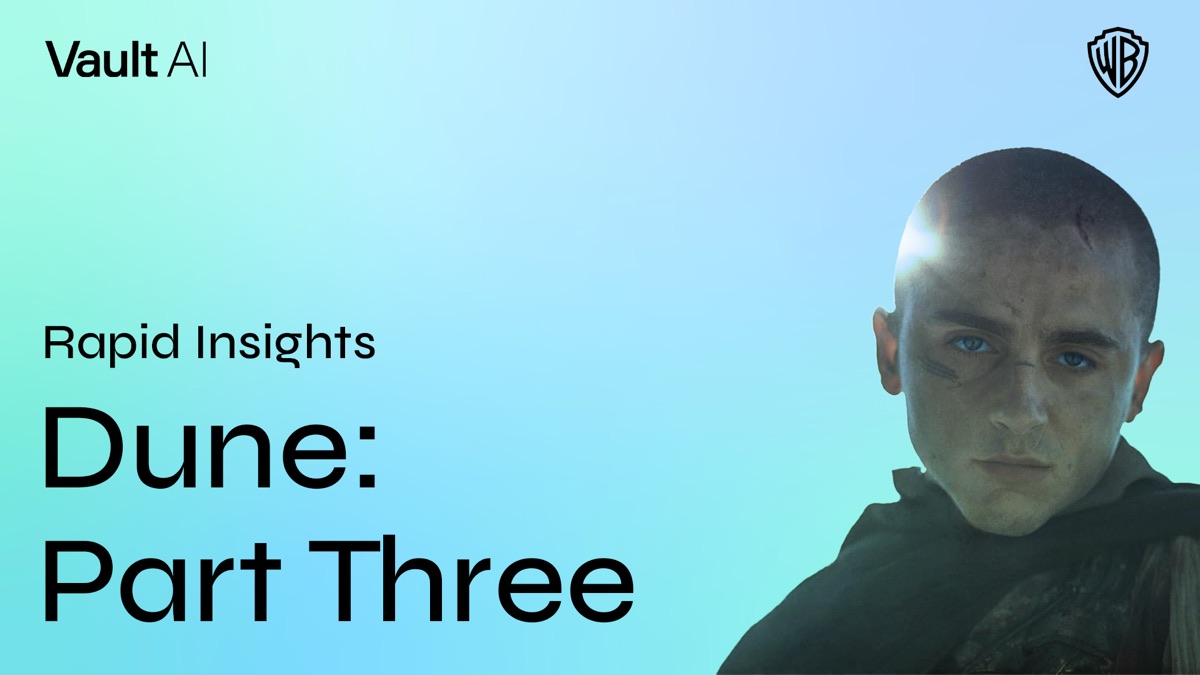
Warner Bros. dropped the first teaser for Dune: Part Three last week to 33.3 million views in six days. That number deserves context. Part Two‘s official trailer sits at 30.7 million views after three years. Part Three‘s teaser passed it in under a week, and it did so by opening with silence, stillness, and sustained dread. The franchise isn’t just sustaining interest, it’s accelerating.
Here’s what you need to know about Dune: Part Three:
Vault AI uses index scores to describe the impact a given story/theme/element will have on specific KPIs:
What has each Dune trailer actually been selling?
The franchise’s emotional center of gravity shifted with each film.
Dune: Part One trailer held shots at three to four seconds per cut, nearly twice the industry average, giving audiences the time to absorb a world they’d never seen at that fidelity. Denis Villeneuve’s Visual Spectacle (135) combined with the Hero’s Journey (131) of Paul Atreides, a young heir discovering his destiny on a planet that wants to kill him, were the sell.
Part Two shifted to Political Intrigue (134), compressing the cuts and pushing dialogue forward until the scale of the story felt less like an invitation and more like a warning. Part Two opened 57% higher than Part One.
Part Three goes further still. The top driver is Moral Consequence (144), what happens when the chosen one wins and the cost lands on everyone he loves. Dynastic Legacy (139) sits underneath it, the weight of the Atreides name and a prophecy that was always a trap. Most sequels amplify action and spectacle. Dune has transformed what it’s asking the audience to feel, and the audience has rewarded it each time.
How do you sell tragedy to a blockbuster audience?
Open with dread and hold it.
The teaser’s first 40% of runtime builds slowly, the war chant escalating underneath while the visuals stay still and silent, sustaining Dread (131) through the opening act before earning any spectacle. Part One hit its first Awe peak within 15 seconds. Part Three opens on Paul Atreides standing in the desert, a man who already knows what he’s about to become, and waits until the audience feels the weight of that before delivering Awe (124) in the second half.
Leading with one Outstanding emotion to earn another is a structural choice, and it’s what makes the war imagery land as consequence rather than spectacle. If a campaign’s emotional register doesn’t match where the story actually is, the audience notices.
What does the comment section tell us that the view count doesn’t?
The view count is broad. The engagement behind it is deep.
Music and sound design dominate 20% of comment conversation. The war chant is identified as the teaser’s emotional backbone well above any visual moment, which tracks with how the editors built the entire opening act around sonic escalation rather than imagery.
Book readers are functioning as the franchise’s credibility signal. A deep-lore Dune Messiah callback drew the second most-liked comment, and their visible enthusiasm tells newcomers the adaptation has stayed faithful.
What does Dune: Prophecy reveal about extending this IP to television?
A familiar world isn’t the same as a reason to care.
Dune: Prophecy opened to 1.2 million viewers on HBO Max, a strong debut for prestige television, and its lead drivers, World-Building (127) and Political Intrigue (121), reflect genuine strengths in how it builds out the universe. What the Part Three teaser demonstrates is a complementary approach: leading with emotional stakes anchored in a single character’s trajectory rather than the world around him.
Game of Thrones’ A Knight of the Seven Kingdoms pointed toward the same lesson when its teaser trailer led with the Dunk and Egg relationship rather than the broader Game of Thrones mythology, and the show opened to 14 million viewers per episode as a result.
For any franchise extending across platforms, the question worth asking is less about what the IP can carry and more about who the audience is being asked to follow.
Methodology
Publicly released trailers for series are evaluated using Vault’s algorithms — utilizing our proprietary 120K+ story element database alongside viewership performance and other datasets — to identify unique combinations of stories, themes, characters, and genre elements that will drive success.