Rapid Insights: ‘A Knight of the Seven Kingdoms’ Exposes the Character Engine Inside Game of Thrones
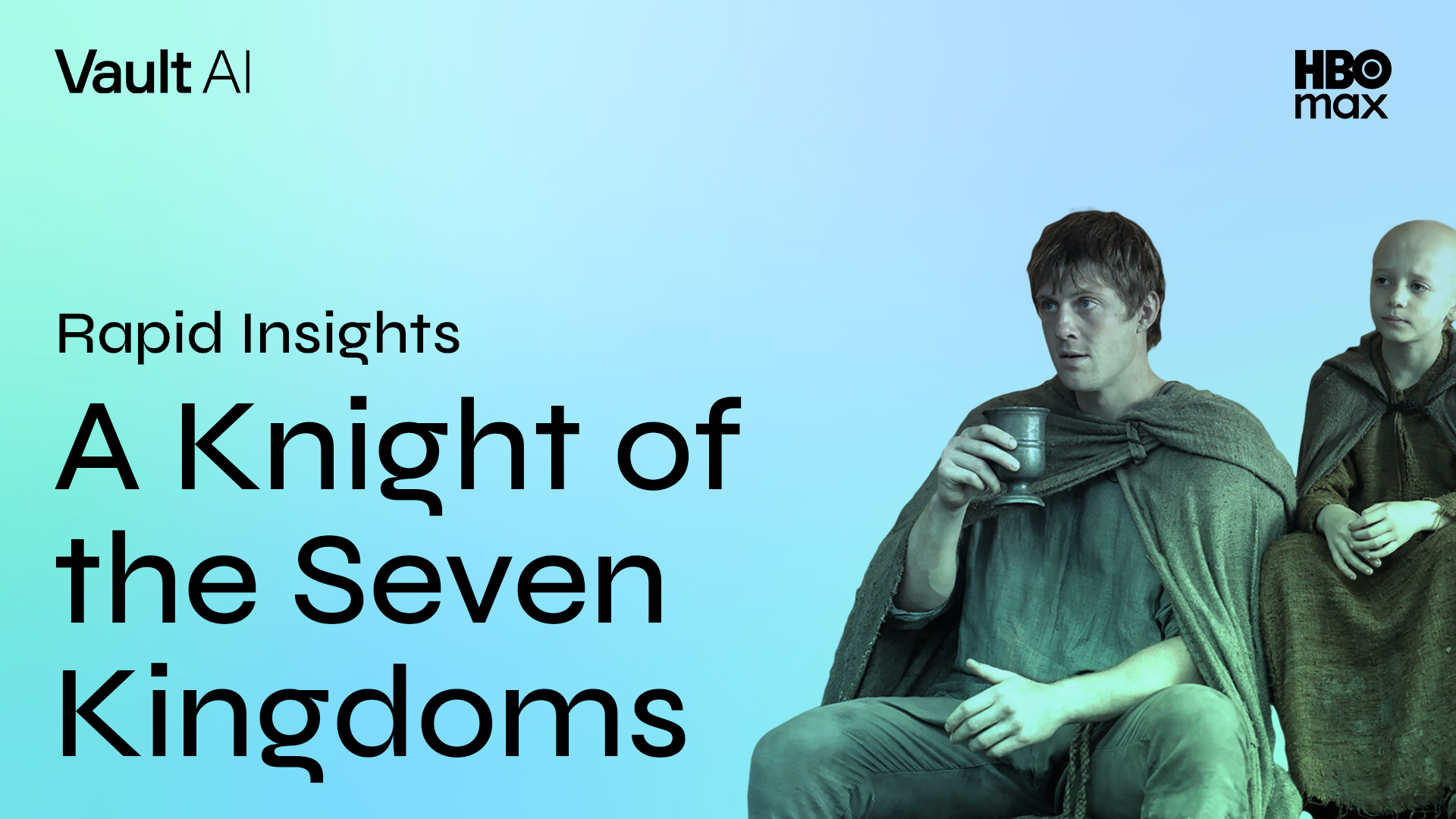
George R.R. Martin’s newest Game of Thrones prequel launched as one of HBO Max’s top three series debuts, attracting 6.7 million viewers in three days. By trading dragon-sized spectacle for practical swordplay, horseback stunts, and character-driven storytelling, A Knight of the Seven Kingdoms delivered one of the biggest HBO Max debuts, proving the franchise’s audience craved heroes as much as dragons.
Here’s what you need to know about A Knight of the Seven Kingdoms:
Vault AI uses index scores to describe the impact a given story/theme/element will have on specific KPIs:
≤79 Disappointing 80-89 Challenging 90-109 Average 110-119 Promising 120+ Outstanding
Who is watching a Game of Thrones show without dragons?
An older, male-leaning audience. AKOTSK skews 62% male with 88% aged 35+, compared to Game of Thrones (53% male, 76% aged 35+) and House of the Dragon (53% male, 90% aged 35+). The male tilt tracks directly to the show’s focus on Physical Activity (136), reflecting the jousting, swordplay, and physical trials of a hedge knight fighting his way into legitimacy, and Honor (128), the chivalric code that defines Dunk’s identity. Both far outpace the franchise’s traditional emphasis on Power (GoT: 128, HotD: 122), signaling an audience drawn to aspirational heroism over political maneuvering.
How does A Knight of the Seven Kingdoms make smallness feel epic?
By grounding stakes in character. AKOTSK reframes franchise storytelling through intimacy rather than spectacle, pairing Action & Violence (120) with Buddy Comedy (117) to relocate tension from the throne room to the bond between hedge knight Ser Duncan “Dunk” the Tall and his diminutive squire, Egg. Bravery (119) and Journey of Self Discovery (112) generate narrative pull not through political scheming but through two people figuring out who they are together. The show’s humor doesn’t play for laughs so much as it reveals character, making Dunk’s naivety and Egg’s quiet cunning feel lived-in and real.
What emotional experience separates this show from the rest of the franchise?
A hero navigating from the bottom up. AKOTSK’s emotional signature clusters around Admiration (117), Submission (114), and Independence (112), three forces that map the internal experience of a lowborn knight in a rigid feudal world. Dunk earns Admiration through action rather than birthright, bends to the rules of a system that wasn’t built for him (Submission), yet continually asserts his own moral code (Independence). Previous franchise entries filtered these same emotions through royals and power brokers. AKOTSK runs them through a nobody with a borrowed sword, and the audience feels the difference.
What keeps viewers coming back week to week?
Common heroism over political schemes. AKOTSK sustains momentum through Dunk’s drive to Overcome Adversity (134) in the Trial of the Seven and outlast his Competition (126), Prince Aerion Targaryen. As battle lines form, the warmth between Dunk and Egg anchors the emotional throughline, giving audiences a relationship to root for rather than a power struggle to decode. Strong IP Extension (118) signals a sustainable franchise blueprint: a hedge knight and his sharp-witted squire, stumbling through a richly realized world together.
—
Most Popular Rapid Insights
Introducing Genre DNA™
Redefine your understanding of TV subgenres
Introducing Genre DNA™ – TV subgenres redefined by groundbreaking AI analysis to reveal the true drivers of viewership.
See the insights that others can’t
Genre DNA™ goes beyond traditional TV genre classifications by analyzing over 1,000 scripted and unscripted series on both linear and SVOD platforms from the last 5 years.
Each Vault Genre DNA™ report offers a precise analysis of your chosen TV subgenre, uncovering its unique drivers of viewership.
*Publicly released trailers for series are evaluated using Vault’s algorithms – utilizing our proprietary 120K+ story element database alongside viewership performance and other datasets – to identify unique combinations of stories, themes, characters, and genre elements that will drive success.
